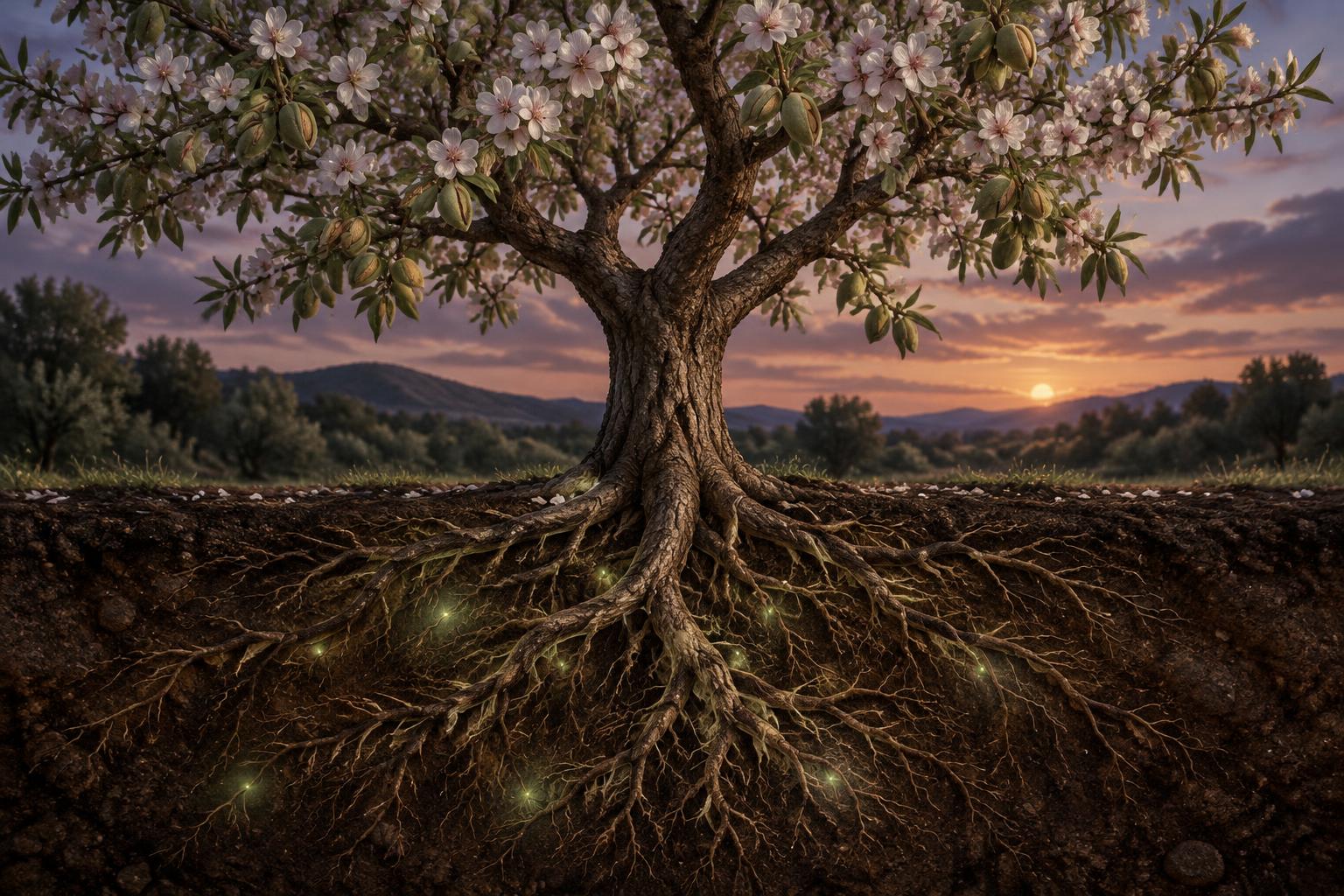
A carton of almond milk begins in an orchard, on a tree related to peaches and plums. This feature follows Prunus dulcis from blossom to the nut behind the drink, without treating every variety or climate as interchangeable.
Illustrative almond · Roots are unscaled artistic interpretation, not measured depth or architecture · Not a GroundWorx customer site
The plant behind the cup
A nut that is really a seed
UC Davis describes the almond as a stone fruit whose edible part is the seed inside the shell, within a hull that splits at maturity. Almond milk is made from those kernels and water; this page is not a recipe or a nutrition comparison.
UC Davis places the almond’s origin in western Asia and the eastern Mediterranean, carried along early trade routes. NC State Extension likewise describes its long cultivation; regional guidance is not a worldwide growing rule.
The almond tree is native to western Asia and the eastern Mediterranean and was carried along early trade routes; today California grows most of the world's supply. That crop history does not establish where almond milk was first made.
General crop stages; timing varies with variety, region and management.
01
Early blossom
Almond blooms early, before the leaves. UC Davis notes bloom time makes the crop weather-sensitive; local conditions belong alongside flowering observations.
At maturity the hulls split and nuts are gathered, dried and processed; the kernels become the drink ingredient. This is crop-to-carton context, not a food-safety or home-processing guide.
The GX-1 Series angle · Almond is a long-lived orchard tree—the kind of plant a buried GX-1F is designed to sit beside for years, recording moisture, temperature and EC in the root zone with nothing above ground in the way of shakers or harvesters. No verified GroundWorx almond trial or sensor result is available in the reviewed project evidence; no root-depth target, predictive accuracy, water savings, health benefit or beverage-quality guarantee is claimed.
A root-zone record adds context beneath the crop: soil moisture, temperature and electrical conductivity at the measured location. Growers can consider that history alongside weather, field observations and their own agronomic advice.
These crop features are research context—not demonstrated crop performance, a sensor deployment prescription or a promise of beverage quality or yield.