

Bidirectional by design
Read every reading, prediction, and recommendation out. Write irrigation events, maintenance activity, and third-party observations back in.


Field-scale irrigation
The iQ SmartTowers extend GroundWorx into production agriculture and high-value perennial crops, reporting soil moisture, temperature, and salinity at depth across open acreage. From old-growth olive trees to large date palms, irrigation decisions follow the root zone — not the calendar.
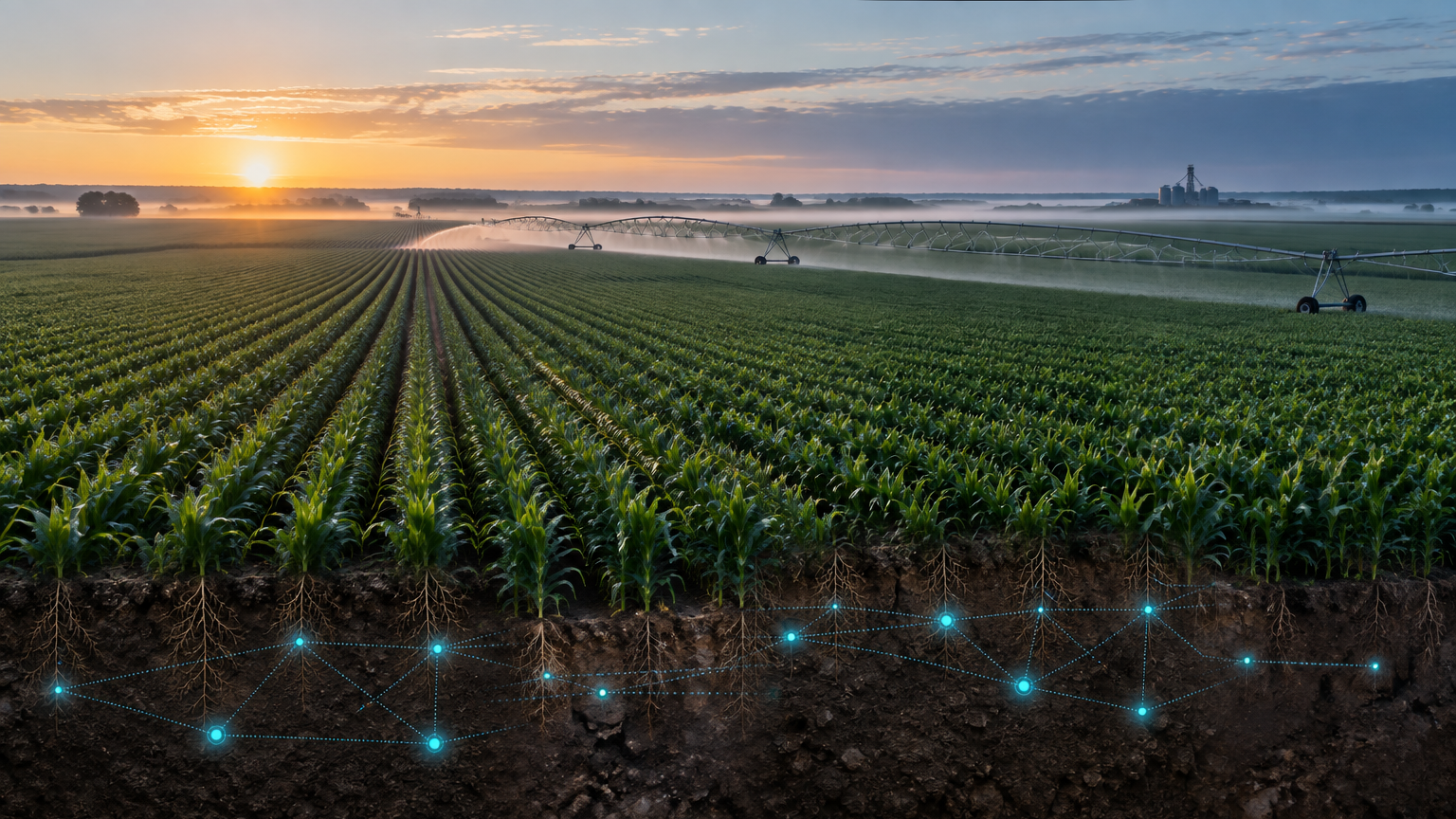
Production Agriculture · Facility estimate · 10,000 crop acres
Live estimateA modeled 25% irrigation reduction for 10,000 crop acres — approximately 3,568,493 gallons potentially conserved per day, annualized.
Potential gallons conserved · Production Agriculture · estimated
10,000 crop acres only · not a global industry total · cumulative since October 9, 2026 · 00:00 UTC
~1,302.5M gallons / year
Potential annual water conserved for 10,000 crop acres
GAIN combines root-zone moisture, salinity, temperature, and weather context to predict irrigation need and reduce unnecessary watering.
Get a customized sensor planPlanning assumption: USDA Irrigation & Water Management Survey / USGS average of ~1.6 acre-feet applied per irrigated acre ≈ 521k gal per acre. These are illustrative facility benchmarks, not verified worldwide industry totals. The ticker spreads annual use evenly across 365 days and applies a 25% potential reduction. It is not measured live water waste, water already saved, or a guarantee. Actual needs and savings vary by climate, season, soil, and irrigation practice.
Partnership · Validation in progress
For growers, the question is what happens in the soil after irrigation. GroundWorx is partnering with RainMaker.earth to independently evaluate the root-zone response to their water-treatment system using repeated soil measurements.
RainMaker.earth provides the irrigation water-treatment system. GroundWorx provides soil telemetry; GAIN adds site history and weather context. The aim is an evidence-based evaluation, not an assumed outcome.
No partnership savings figures or completed results are published. Soil readings do not directly measure plant uptake or gallons conserved; water-use records and agronomic checks are needed. Existing GroundWorx case studies are separate.
GAIN / Water savings estimator
US water rate region
Baseline annual use
5,210M gal
Estimated irrigation per year
Water conserved (25%)
1,302.5M gal
Modeled annual gallons conserved
Annual utility cost savings
$9,768,750 / yr
West · $7.50 per 1,000 gal
Estimate only, not a quote or guarantee. Basis: USDA Irrigation & Water Management Survey / USGS average of ~1.6 acre-feet applied per irrigated acre ≈ 521k gal per acre. Savings use a 25% reduction benchmark; annual utility savings use the selected modeled US regional water rate (West: $7.50 per 1,000 gallons), not a local utility quote. Map zones are schematic, not state-level service boundaries. Sources: GCSAA, USDA/USGS, and university extension irrigation benchmarks for water use. Actual results depend on climate, soil, water source, local utility rates, and current practices.
Get a customized sensor planWhat you are up against
What changes
Typical deployment
Open API
GAIN is built as an open, bidirectional platform. Root-zone telemetry streams out to any system you run, and context streams back in — irrigation run times, agronomic events, imagery, weather — so every prediction is made with the full picture. You own your data, and you can move it.
Read every reading, prediction, and recommendation out. Write irrigation events, maintenance activity, and third-party observations back in.
REST endpoints, webhooks, scoped API keys, and scheduled exports. If a platform speaks HTTP, GroundWorx can speak to it.
Raw and derived telemetry are exportable at any time, in open formats, to your own warehouse. No lock-in, no gatekeeping, no export fee.
Get started
Tell us about your site and we will walk through where sensors belong, what GAIN would watch, and what a first season looks like.