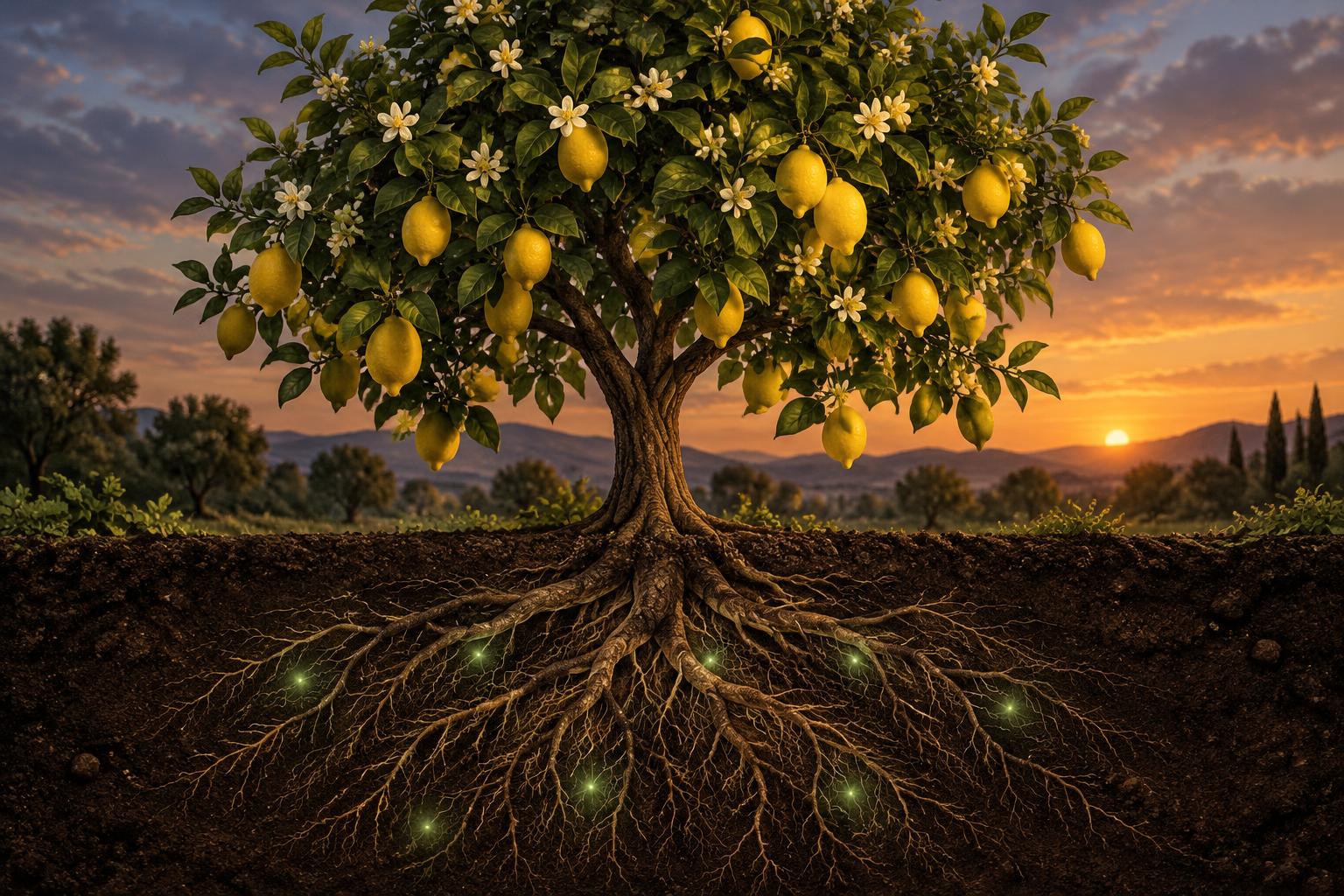
A glass of lemonade starts years earlier, on an evergreen tree that keeps its leaves while it carries blossom and fruit. This feature follows Citrus limon from the orchard to the cup, without treating every lemon variety or climate as interchangeable.
Illustrative lemon · Roots are unscaled artistic interpretation, not measured depth or architecture · Not a GroundWorx customer site
The plant behind the cup
An evergreen, not an annual
NC State Extension describes Citrus limon as a small evergreen tree. Unlike the grain and vine crops elsewhere in this series, a lemon tree keeps its canopy year-round where winters are mild, so each harvest rests on a root system that never fully rests.
NC State Extension documents the fruit’s juice and peel as culinary ingredients. Lemonade is a nonalcoholic drink built from the juice; lemon zest also flavors other drinks. This page concerns the fruit, not a processing recipe or a health claim.
NC State Extension places the lemon’s origin in Asia, and the exact early history of the cultivated lemon is not presented as settled here. UF/IFAS describes lemons and limes as warm-climate citrus for Florida gardens; regional guidance is not a worldwide growing rule.
NC State Extension places the lemon's origin in Asia; the exact early history of the cultivated lemon is not treated as settled here. A qualified plant origin does not establish a single birthplace or invention date for lemonade.
General crop stages; timing varies with variety, region and management.
01
Blossom on an evergreen
UF/IFAS describes fragrant white citrus blossoms. In warm climates, bloom and fruit can overlap on the same tree, so the “season” is less fixed than with deciduous fruit.
Small fruitlets develop behind the flowers. Not every blossom becomes a harvested lemon; local weather and tree condition belong alongside flowering observations.
Fruit grows and gradually colors. UF/IFAS notes that harvest timing in Florida differs by variety; those regional dates are not one worldwide calendar.
Mature fruit is picked and the juice becomes the drink ingredient. This is crop-to-cup context, not a preservation, food-safety or home-processing guide.
The GX-1 Series angle · Citrus is a long-lived evergreen tree crop—the kind of plant a buried GX-1F is designed to sit beside for years, recording moisture, temperature and EC in the root zone with nothing above ground in the way of mowers or pickers. No verified GroundWorx lemon trial or sensor result is available in the reviewed project evidence; no root-depth target, predictive accuracy, water savings, health benefit or beverage-quality guarantee is claimed.
A root-zone record adds context beneath the crop: soil moisture, temperature and electrical conductivity at the measured location. Growers can consider that history alongside weather, field observations and their own agronomic advice.
These crop features are research context—not demonstrated crop performance, a sensor deployment prescription or a promise of beverage quality or yield.