Many flowers, one fruit
Both sources describe a herbaceous perennial with a central flowering structure. Individual fruits develop together into the pineapple; UF/IFAS documents its use as juice.
Source ↗



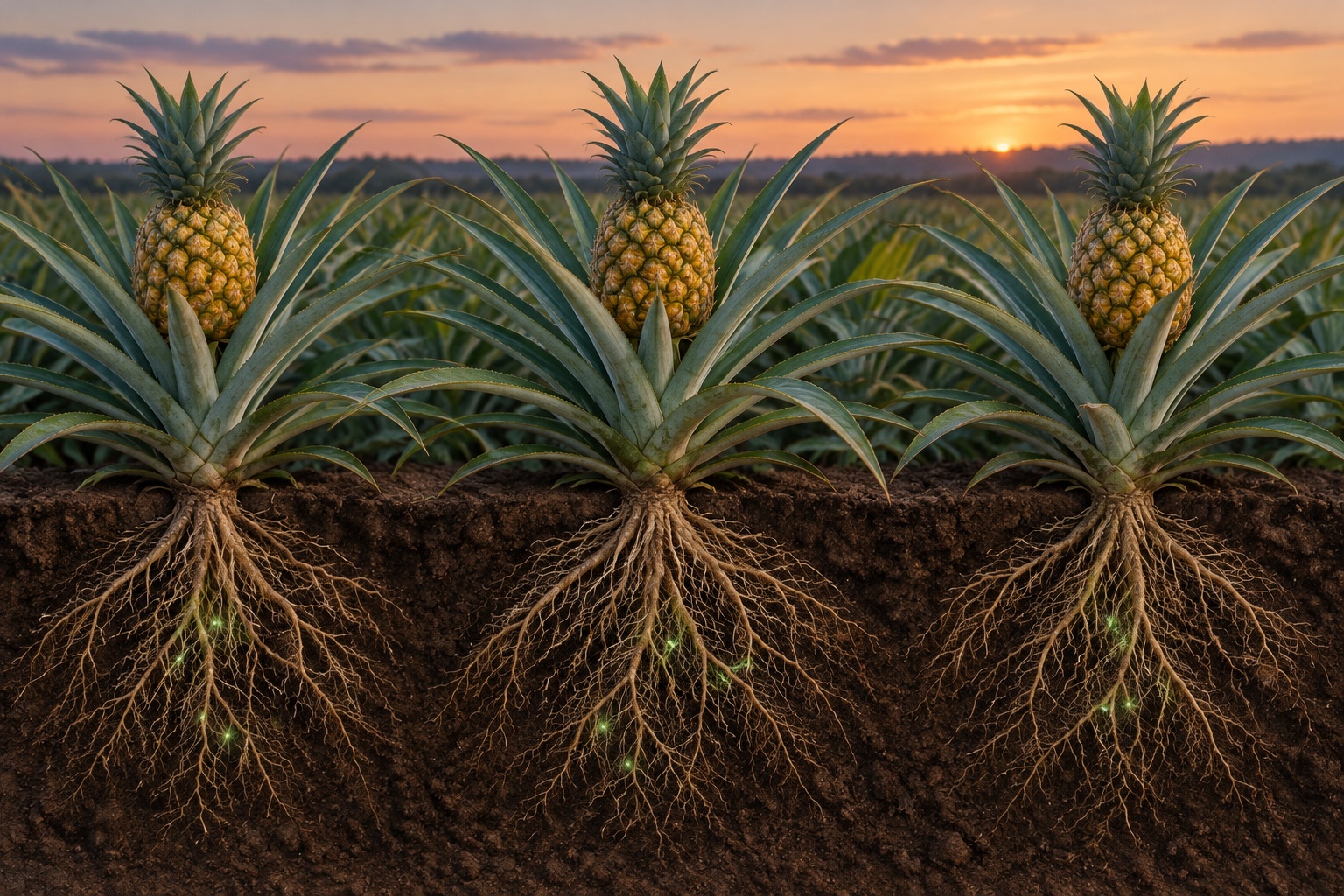
Ananas comosus · Herbaceous perennial · Nonalcoholic
Pineapple juice begins close to the ground, on a plant with sword-shaped leaves. Its familiar fruit develops from many flowers—not from a tree.
Illustrative crop · Roots are unscaled artistic interpretation, not measured depth or architecture · Not a GroundWorx customer site
Both sources describe a herbaceous perennial with a central flowering structure. Individual fruits develop together into the pineapple; UF/IFAS documents its use as juice.
Source ↗UF/IFAS describes origins and long cultivation in tropical America and the Caribbean. NC State describes tropical South American nativity. These accounts are not a single birthplace for pineapple juice.
Source ↗Both sources warn against poorly drained or persistently wet conditions. UF/IFAS recommends sun in its Florida landscape setting; NC State discusses indirect light and partial shade in container contexts. These are not one universal exposure rule.
Source ↗Pineapple Ananas comosus
UF/IFAS describes pineapple as cultivated by Indigenous people in the tropical Americas and Caribbean for thousands of years, then distributed to other continents by explorers. NC State describes its tropical South American origin. Crop dispersal does not date the first pineapple juice.
UF/IFAS — Pineapple Growing in the Florida Home Landscape ↗General crop stages; timing varies with variety, region and management.
01
Both sources describe vegetative propagation from crowns and other shoots. This is plant-cycle context, not a planting protocol.
Source ↗02
Flowers appear in a central inflorescence capped by leaves. The plant does not produce pineapples on woody tree branches.
Source ↗03
Individual fruits fuse into the familiar pineapple. UF/IFAS explains that suckers can support subsequent crop cycles after the first fruit.
Source ↗04
UF/IFAS describes fruit harvested for fresh use and juice. No fixed harvest duration, ripening shortcut or home-preservation instruction is provided.
Source ↗The GX-1 Series angle · A managed pineapple planting could pair location-specific soil moisture, temperature and electrical-conductivity records with crop stages, cultivar identity and weather. No verified GroundWorx pineapple trial is available in the reviewed project evidence; no placement depth, predictive accuracy, water savings, health benefit or beverage-quality guarantee is claimed.
A root-zone record adds context beneath the crop: soil moisture, temperature and electrical conductivity at the measured location. Growers can consider that history alongside weather, field observations and their own agronomic advice.
These crop features are research context—not demonstrated crop performance, a sensor deployment prescription or a promise of beverage quality or yield.
Discuss a grower pilot