Fragaria × ananassa · A low perennial · Nonalcoholic
Strawberry Drinks: The Low Perennial
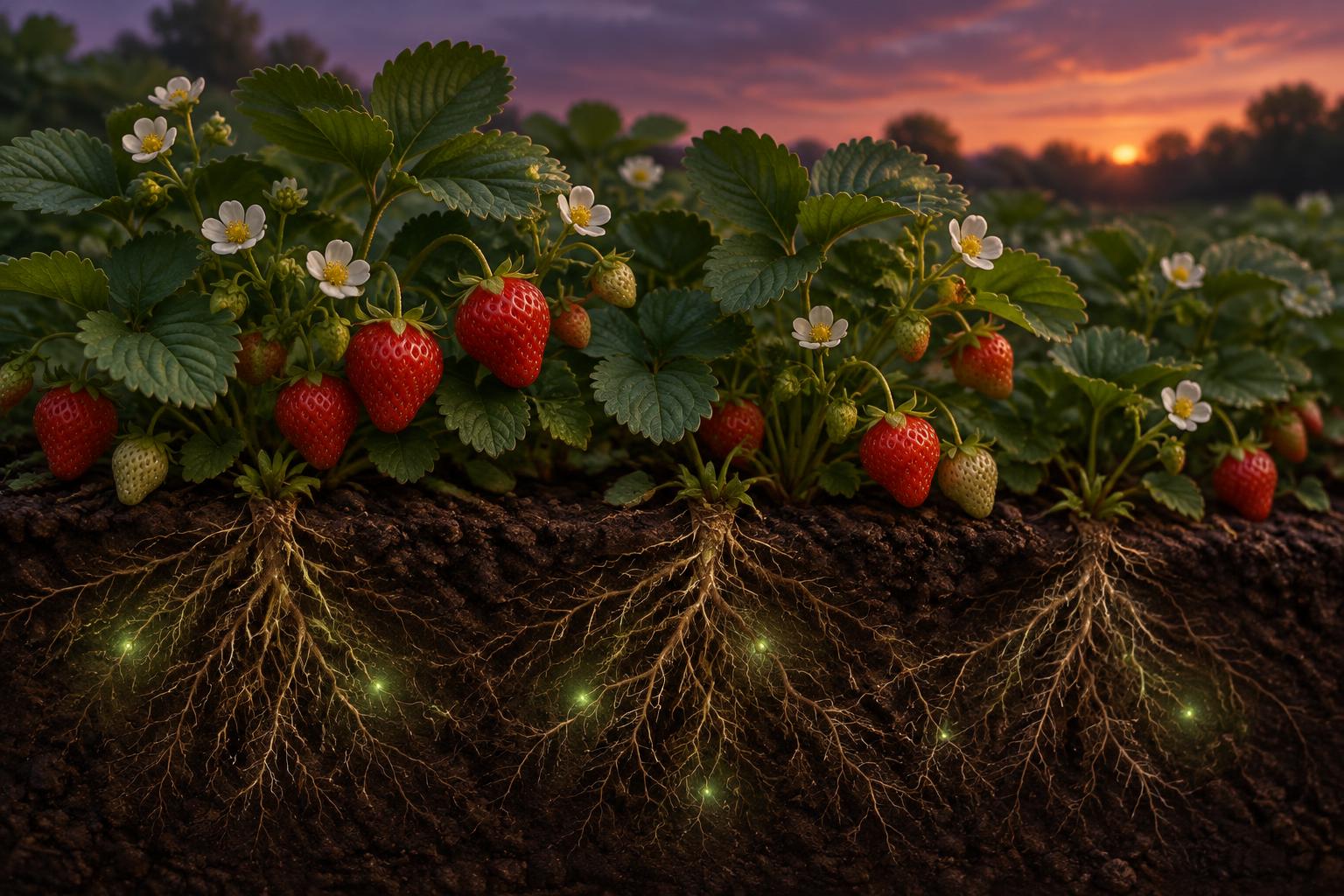
A strawberry smoothie starts inches above the soil, on a low perennial plant with a shallow, fibrous root system. This feature follows Fragaria × ananassa from the bed to the blender, without treating every variety or climate as interchangeable.
Illustrative strawberry · Roots are unscaled artistic interpretation, not measured depth or architecture · Not a GroundWorx customer site
The plant behind the cup
A hybrid from two continents
NC State Extension describes the garden strawberry as a hybrid of two wild strawberries of the Americas, first documented in 18th-century France. The familiar fruit is a garden creation, not a single wild species.
NC State Extension describes the strawberry’s fleshy red receptacle carrying the true fruits—the tiny achenes—on its surface. The drink ingredient is that flesh, blended or juiced; this page is not a recipe or a health claim.
UF/IFAS describes strawberry as a low-growing perennial with a shallow root system, grown in beds with attention to moisture. Regional planting windows are not a worldwide calendar.
The garden strawberry is a hybrid that arose in Europe from two wild strawberries of the Americas, first documented in 18th-century France. A hybrid origin in a European garden is not a single wild birthplace, and it does not date the first strawberry drink.
Ripe berries are picked and the flesh becomes the drink ingredient. This is crop-to-cup context, not a preservation, food-safety or home-processing guide.
The GX-1 Series angle · Strawberry is a shallow-rooted bed crop, where a GX-1A can record moisture, temperature and EC in the upper root zone through the season. No verified GroundWorx strawberry trial or sensor result is available in the reviewed project evidence; no root-depth target, predictive accuracy, water savings, health benefit or beverage-quality guarantee is claimed.
A root-zone record adds context beneath the crop: soil moisture, temperature and electrical conductivity at the measured location. Growers can consider that history alongside weather, field observations and their own agronomic advice.
These crop features are research context—not demonstrated crop performance, a sensor deployment prescription or a promise of beverage quality or yield.