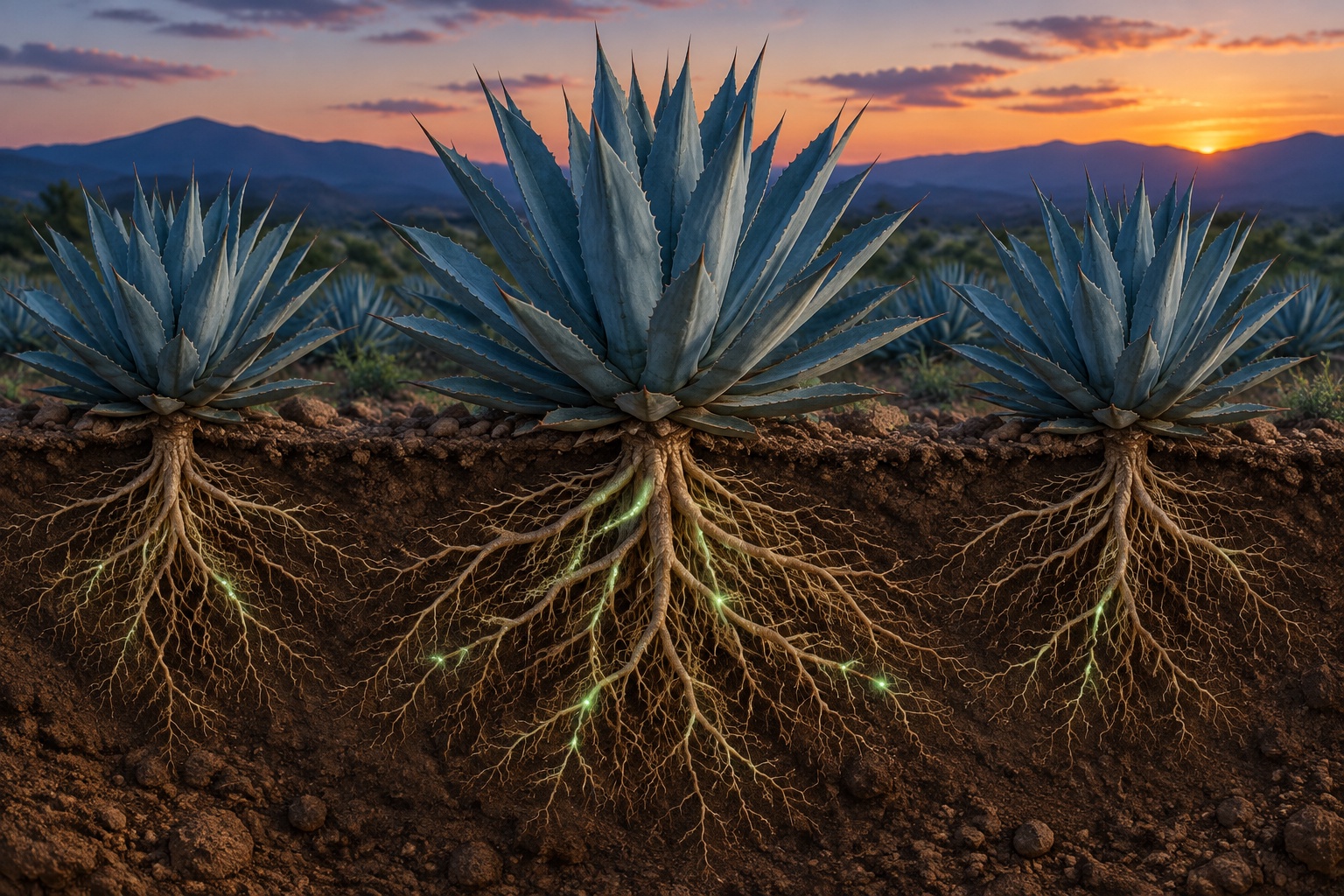
Before tequila reaches a glass, blue agave is a living rosette rooted in Mexican soil. This crop story is distinct from the many agave species behind mezcal.
Illustrative crop · Roots are unscaled artistic interpretation, not measured depth or architecture · Not a GroundWorx customer site
The plants behind the pour
A protected identity
U.S. regulations recognize tequila as a distinctive product of Mexico made under Mexican laws. The botanical review identifies blue agave, Agave tequilana Weber var. azul, with tequila. This page does not reproduce every production or labeling requirement.
The botanical review places commercial blue-agave cultivation within a much longer Indigenous history of agave management. Tequila’s specific identity is not a universal rule for every agave drink.
The review describes agave stems as a sugar source for spirits. The harvested central stem, commonly called the piña, is distinct from pineapple fruit and from the roots.
Blue agave descends from Agave angustifolia, part of a long history of Indigenous agave selection in Mexico before European colonization. In 1974, tequila received a designation of origin tied to blue agave from the Tequila region.
General crop stages; timing varies with variety, region and management.
01
Young rosette
The review describes vegetative propagation and managed agave cultivation. Establishment is part of a multiyear crop cycle, not a fixed worldwide duration.
Agave develops a rosette of succulent leaves and accumulates resources in its stem. CAM photosynthesis is plant physiology, not a verified GroundWorx water-saving result.
Harvest timing is a crop-management decision. The review distinguishes harvested spirit crops from plants allowed to flower; no harvest-age prescription is provided here.
The stem supplies material for spirit production. Legal tequila identity remains separate from botanical growing context; this is not a distillation recipe.
The GX-1 Series angle · A managed blue weber agave planting could pair location-specific soil moisture, temperature and electrical-conductivity records with crop stages, cultivar identity and weather. No verified GroundWorx tequila trial is available in the reviewed project evidence; no placement depth, predictive accuracy, water savings, health benefit or beverage-quality guarantee is claimed.
A root-zone record adds context beneath the crop: soil moisture, temperature and electrical conductivity at the measured location. Growers can consider that history alongside weather, field observations and their own agronomic advice.
These crop features are research context—not demonstrated crop performance, a sensor deployment prescription or a promise of beverage quality or yield.