Allowed only as “thujone-free”
TTB Industry Circular 2007-5 approves the term absinthe on U.S. labels only when the product is thujone-free under FDA regulation 21 CFR 172.510, and restricts imagery suggesting hallucinogenic effects.
Source ↗



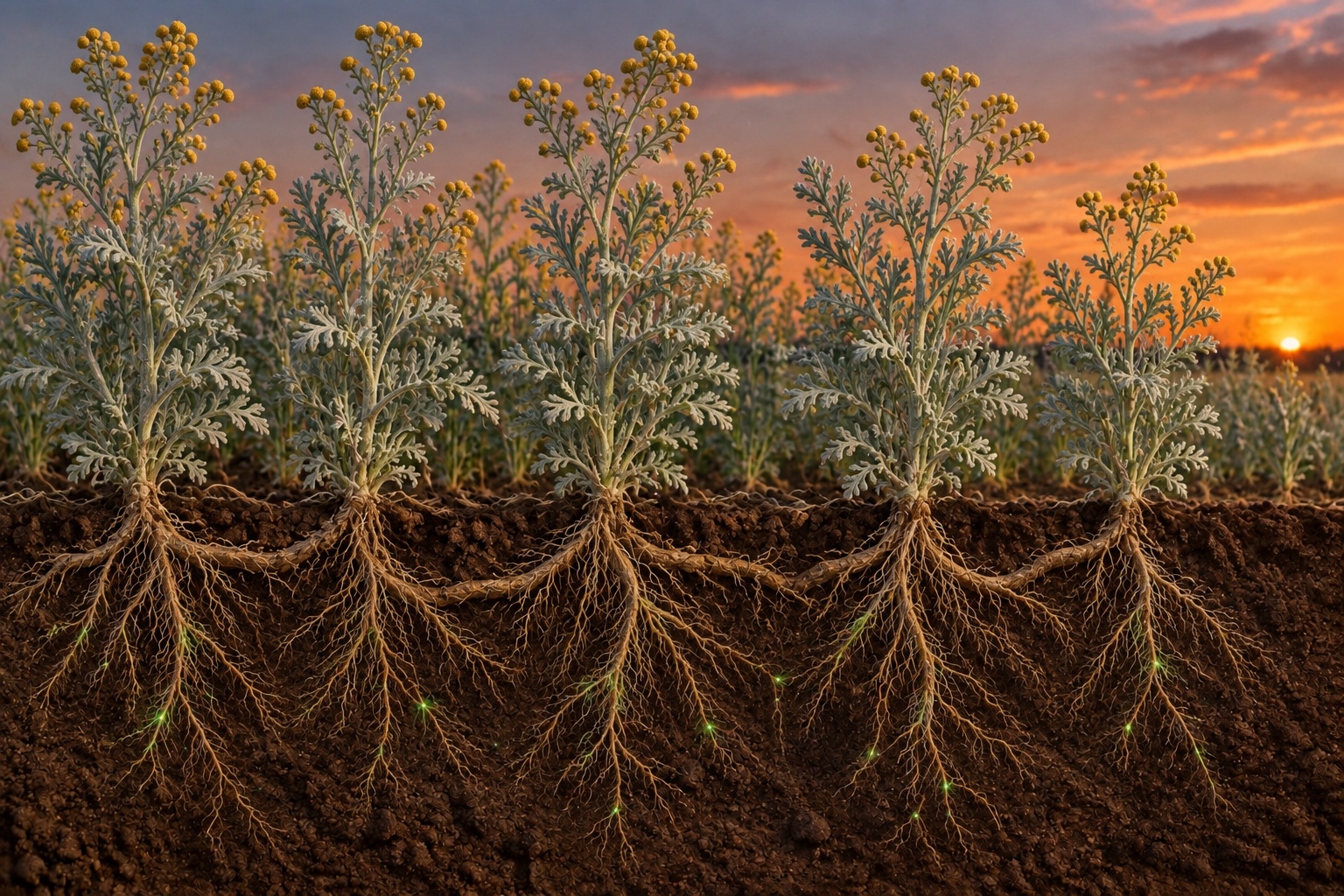
Artemisia absinthium · Herbaceous perennial
Absinthe is an anise-flavored spirit made with herbs including grand wormwood, a silvery perennial. Its U.S. story is as much about labeling rules as about the plant.
Illustrative wormwood · Roots are unscaled artistic interpretation, not measured depth or architecture · Not a GroundWorx customer site
TTB Industry Circular 2007-5 approves the term absinthe on U.S. labels only when the product is thujone-free under FDA regulation 21 CFR 172.510, and restricts imagery suggesting hallucinogenic effects.
Source ↗NC State Extension describes Artemisia absinthium as an herbaceous perennial native to Eurasia, with soft gray foliage and rhizomatous growth.
Source ↗NC State notes it has naturalized in waste places in the northern United States and lists it as a noxious weed in the Midwest. This page does not encourage planting it.
Source ↗Grand wormwood Artemisia absinthium
NC State Extension describes grand wormwood as an herbaceous perennial native to Eurasia that has naturalized in disturbed places in the northern United States.
NC State Extension — Artemisia absinthium ↗General crop stages; timing varies with variety, region and management.
01
Growth returns from the perennial crown and rhizomes; NC State suggests pinching tips in spring for bushier plants.
Source ↗02
Silver-gray leaves fill out in full to part sun. NC State notes the plant may struggle in humid summers.
Source ↗03
Small yellow flowers appear in late summer; deadheading limits self-seeding.
Source ↗04
NC State prefers well-drained soil and warns of root rot in wet soils. No moisture threshold is supplied here.
Source ↗The GX-1 Series angle · A managed wormwood planting could pair location-specific soil moisture and temperature records with weather, given its sensitivity to wet soils. No verified GroundWorx wormwood deployment, moisture target, thujone effect or absinthe-quality improvement is claimed.
A root-zone record adds context beneath the crop: soil moisture, temperature and electrical conductivity at the measured location. Growers can consider that history alongside weather, field observations and their own agronomic advice.
These crop features are research context—not demonstrated crop performance, a sensor deployment prescription or a promise of beverage quality or yield.
Discuss a grower pilot