



Tequila Talk · Ground truth
The Agave Story
Every bottle of tequila starts in the ground. Here is the whole story of blue agave — the soil it loves, the climate it needs, where it grows, how it becomes tequila and how tequila came to be.
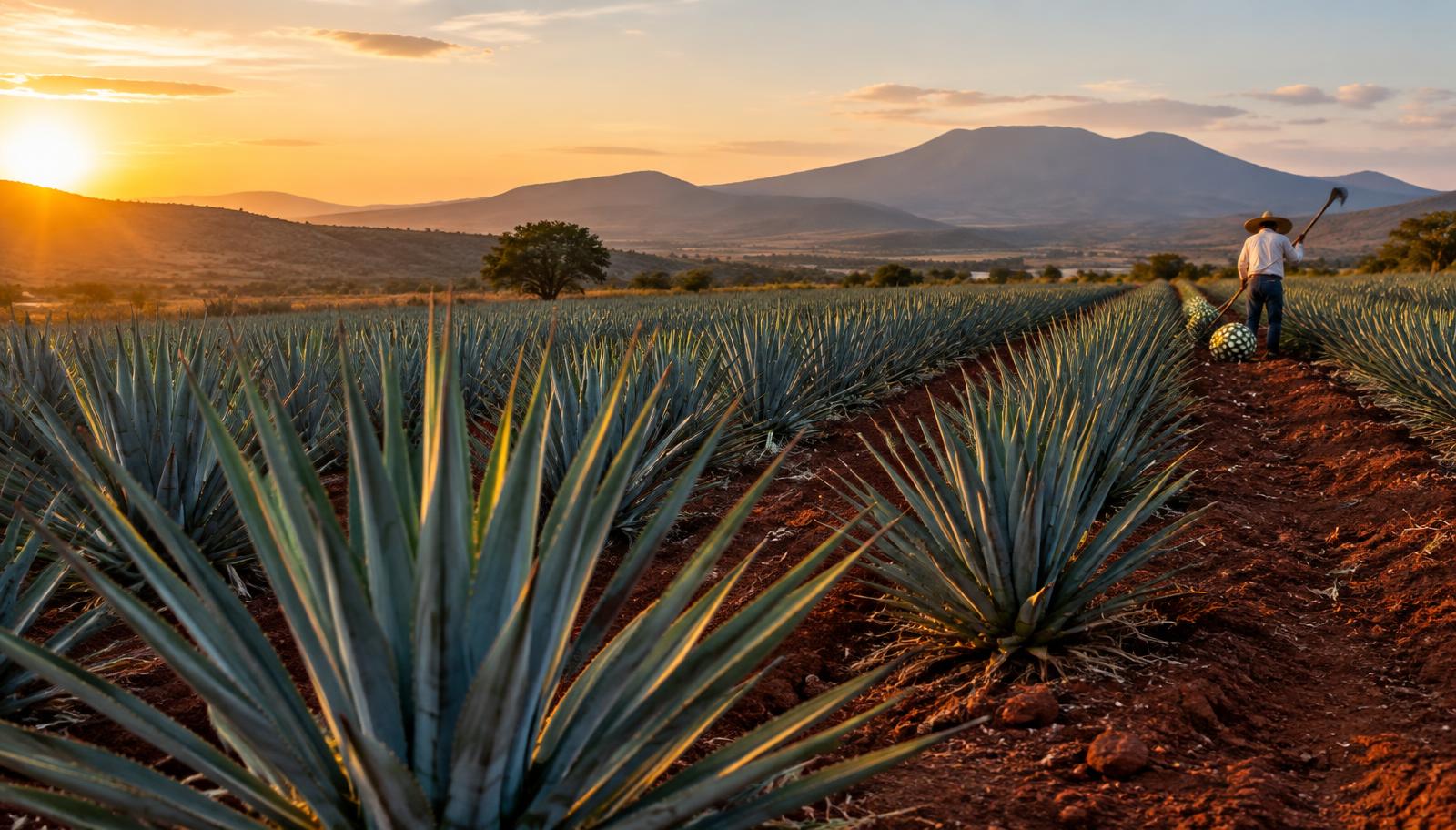
Illustrative image.
01 · The plant
Blue agave: a succulent, not a cactus
Tequila can only be made from one plant: Agave tequilana Weber, blue variety — the blue agave. It is a succulent in the asparagus family, not a cactus, and it grows as a rosette of stiff, blue-grey, spine-tipped leaves (pencas) around a dense core called the piña.
Agave uses CAM photosynthesis: it opens its pores at night, when air is cooler and more humid, and keeps them closed through the heat of the day. That is how it stores water and thrives where most crops would wilt — a natural lesson in water efficiency.
A blue agave takes roughly six to eight years (sometimes longer) to mature. Left alone it would send up a tall flower stalk (the quiote) once and then die; growers cut the stalk so the plant's sugars stay in the piña.
- Species
- Agave tequilana Weber, blue variety
- Time to harvest
- About 6–8 years
- Harvested part
- The piña (heart)
- Water strategy
- CAM — breathes at night
02 · Soil
The ground it grows best in
Blue agave wants soil that drains fast. Standing water around the roots leads to rot, so it does best on slopes and loose, well-aerated ground rather than heavy, waterlogged clay.
The classic tequila soils are volcanic. In the Highlands (Los Altos de Jalisco) the soil is famously iron-rich red clay-loam; in the Lowlands around the town of Tequila and the Tequila Volcano it is darker volcanic soil with obsidian fragments. Growers and distillers often say the two regions produce different flavor — highland agave is commonly described as sweeter and fruitier, lowland agave as earthier and more herbal.
Agave is shallow-rooted, with a wide, fibrous root system that sits mostly in the top layers of soil. That makes root-zone moisture and drainage the conditions that matter most to the plant.
- Drainage
- Fast-draining is essential
- Highlands
- Red, iron-rich volcanic clay-loam
- Lowlands
- Dark volcanic soil with obsidian
- Roots
- Shallow and wide-spreading
03 · Climate
Sun, a rainy season and no hard frost
Blue agave grows best in a warm, semi-arid climate with lots of sun. Western Mexico gives it a summer rainy season followed by a long dry season, and the plant banks water during the rains to carry it through the dry months.
Its weakness is cold. Frost damages leaves and piñas, and hard freezes can wipe out fields, so it is grown where winters stay mild. Much of the best agave comes from elevations of roughly 1,000 to 2,000+ meters, where days are warm and nights are cool.
- Climate
- Warm, sunny, semi-arid
- Rain pattern
- Summer rains, long dry season
- Biggest risk
- Frost and standing water
- Elevation
- Roughly 1,000–2,000+ m
04 · Where
Where tequila is allowed to come from
Tequila has a protected Denomination of Origin, first declared by Mexico in 1974. Only spirit made from blue agave grown and distilled inside that zone can be called tequila.
The zone covers the entire state of Jalisco plus selected municipalities in Guanajuato, Michoacán, Nayarit and Tamaulipas. The heart of it is the town of Tequila, Jalisco, at the foot of the Tequila Volcano, and the Los Altos highlands to the east.
In 2006 UNESCO named the Agave Landscape and Ancient Industrial Facilities of Tequila a World Heritage Site, recognizing the blue agave fields and historic distilleries around Tequila, Amatitán and El Arenal.
- Protected since
- 1974
- States
- Jalisco + parts of Guanajuato, Michoacán, Nayarit, Tamaulipas
- Heartland
- Tequila, Jalisco and Los Altos
- UNESCO
- World Heritage Site, 2006
05 · How it's made
From field to bottle
Harvest (la jima): Skilled harvesters called jimadores use a flat, razor-sharp tool called a coa to cut away the leaves, leaving the piña. Piñas commonly weigh tens of kilograms and large ones can exceed 50 kg.
Cooking: The piñas are slow-baked in traditional stone or brick ovens (hornos) or in steel pressure cookers (autoclaves). Cooking turns the plant's stored inulin into fermentable sugars and gives the cooked agave its sweet, caramel smell. (Some producers use a diffuser, a faster industrial method.)
Milling: The cooked agave is crushed to release its sweet juice (aguamiel). The traditional way is a tahona — a huge volcanic-stone wheel; most distilleries now use roller mills.
Fermentation: The juice is fermented with yeast in wood or steel tanks for days, becoming a low-alcohol 'agave wine.'
Distillation: By law tequila is distilled at least twice, usually in copper pot stills or column stills. The first run makes a rough spirit (ordinario); the second produces tequila.
Resting and aging: It is bottled right away or aged in oak barrels, then certified by the Tequila Regulatory Council (CRT) under Mexico's official tequila standard (NOM-006).
06 · In the glass
Reading a tequila label
100% agave tequila is made only from blue agave sugars. Tequila labeled simply 'tequila' (often called mixto) must contain at least 51% agave sugars; the rest can come from other sugars.
Blanco (silver): unaged or rested under two months. Joven (gold): typically blanco blended with aged tequila or allowed additives. Reposado: aged at least two months in oak. Añejo: aged at least one year in oak containers of up to 600 liters. Extra añejo: aged at least three years.
Every authentic bottle carries a NOM number identifying the distillery that made it — a handy fact for Diego's Tequila of the Week.
- Blanco
- Unaged / under 2 months
- Reposado
- 2+ months in oak
- Añejo
- 1+ year in oak
- Extra añejo
- 3+ years in oak
07 · The story
How tequila came to be
Long before tequila, people in Mesoamerica used agave for food, fiber, needles and drink. The Aztecs and earlier cultures fermented agave sap into pulque, a milky, mildly alcoholic drink tied to ritual and to Mayahuel, the goddess of the agave.
When the Spanish arrived in the 1500s they brought distillation. With their brandy running short, they began distilling cooked agave, creating what was called mezcal wine (vino de mezcal). The area around the town of Tequila became famous for it.
In the 1600s the Marquis of Altamira is credited with building one of the first large-scale distilleries in the region. In 1795 the Spanish Crown granted José María Guadalupe de Cuervo one of the first official licenses to produce the spirit commercially.
In the 1800s Don Cenobio Sauza began exporting to the United States, helped popularize the name 'tequila' and is credited with identifying blue agave as the best plant for it. The railroad carried it farther, and in the 20th century tequila became a symbol of Mexico, gaining its protected origin in 1974 and its regulatory council in 1994.
Today blue agave remains a slow crop: every bottle starts with a plant that spent years reading its own soil and weather — which is exactly why it belongs on Tequila Talk.
Tequila timeline
- Pre-1500sMesoamerican peoples ferment agave sap into pulque
- 1500sSpanish distillation creates vino de mezcal
- 1600sEarly large-scale distilling near Tequila
- 1795José María Guadalupe de Cuervo receives an early royal license
- 1800sCenobio Sauza exports to the U.S. and champions blue agave
- 1974Tequila Denomination of Origin declared
- 1994Tequila Regulatory Council (CRT) founded
- 2006UNESCO lists the Agave Landscape of Tequila
Compiled from widely published tequila history and Mexico's tequila regulations (NOM-006, CRT). Dates for early history are traditional accounts. Please enjoy responsibly, 21+.
Back to Tequila Talk