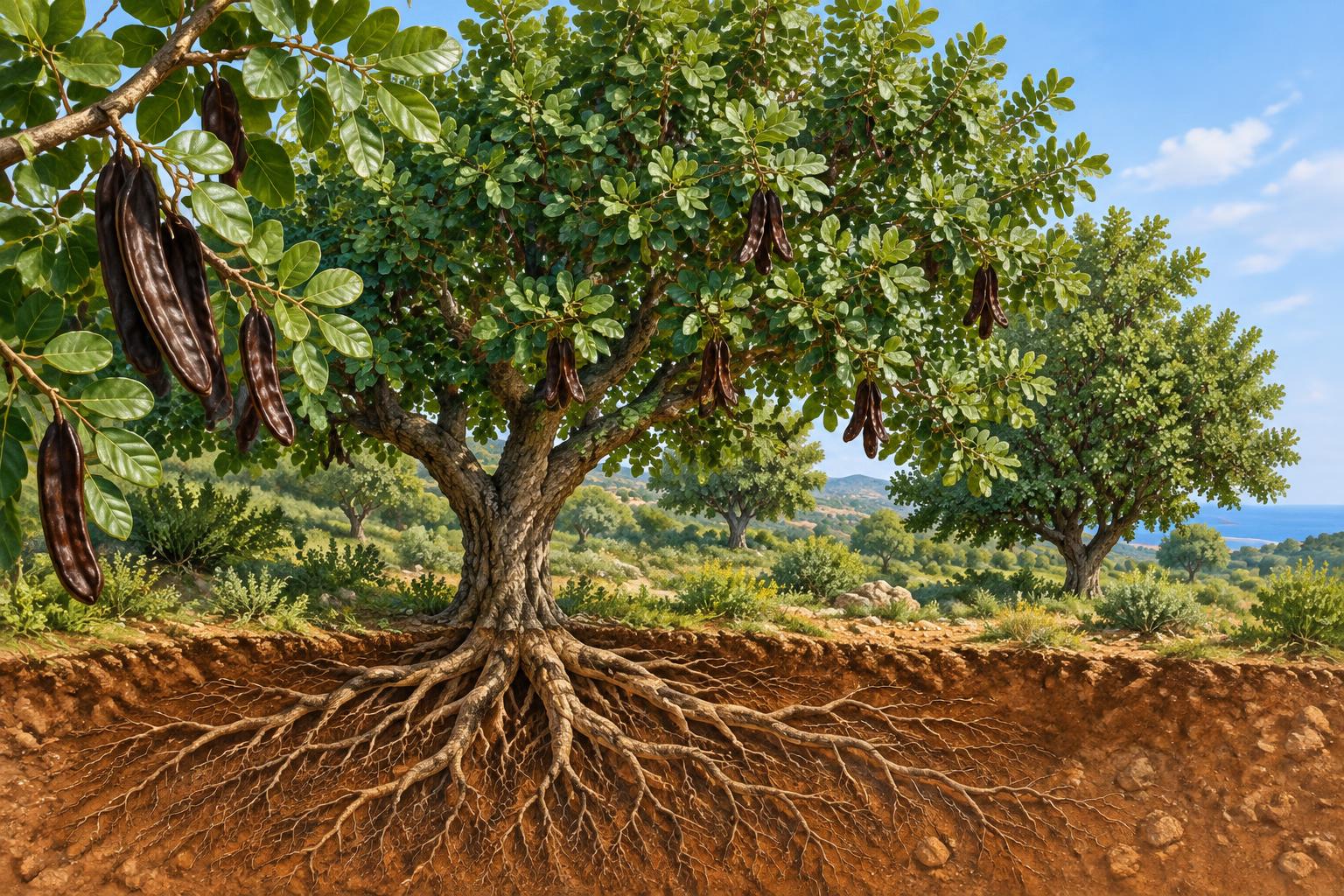
Another tree-to-cup story grows around the Mediterranean. Carob’s pods provide a chocolate-substitute ingredient for drinks; they are not cacao pods, and carob is a different plant from Theobroma cacao.
Illustrative carob · Roots are unscaled artistic interpretation, not measured depth or architecture · Not a GroundWorx customer site
The plant behind the cup
The pod, not a cacao bean
NC State documents carob seedpods ground into powder for drinks as a chocolate substitute. Oregon State likewise describes milled pods as a cocoa substitute, while Stanford records beverage uses. This feature concerns the pod ingredient, not a seed-roasting recipe.
UC IPM describes full sun and cautions against overwatering. NC State also describes good drainage and shade intolerance. These are general growing conditions, not a soil-moisture target or a site-specific watering schedule.
UC IPM and Oregon State describe carob as drought tolerant. Oregon State separately notes that additional water is needed for quality pods. Surviving dry conditions and producing a commercial pod crop are not interchangeable claims.
Oregon State describes carob as native to the Mediterranean region, with cultivars selected for commercial production and introductions to Mexico and southern California. It also notes naturalization and invasive status in parts of Southern California. This plant history does not establish a single birthplace for carob drinks or recommend planting it in every region.
Oregon State describes small flowers on old wood and sometimes the trunk. Flowers are usually male or female, but some have both parts; a universal two-tree rule would miss that variation.
UC IPM describes female trees producing dark brown leathery pods. Variety, pollination and local conditions belong in a grower’s crop records; no worldwide harvest month is specified here.
Ground pods provide a chocolate-substitute ingredient for drinks. This is an ingredient pathway, not a complete processing recipe or food-safety guide.
The GX-1 series angle · A managed carob planting could pair location-specific soil moisture, temperature and electrical-conductivity records with flowering, pod development and weather observations. No verified GroundWorx carob trial or sensor result is available in the reviewed project evidence; no water savings, predictive accuracy, root-depth target or pod-quality guarantee is claimed.
A root-zone record adds context beneath the crop: soil moisture, temperature and electrical conductivity at the measured location. Growers can consider that history alongside weather, field observations and their own agronomic advice.
These crop features are research context—not demonstrated crop performance, a sensor deployment prescription or a promise of beverage quality or yield.