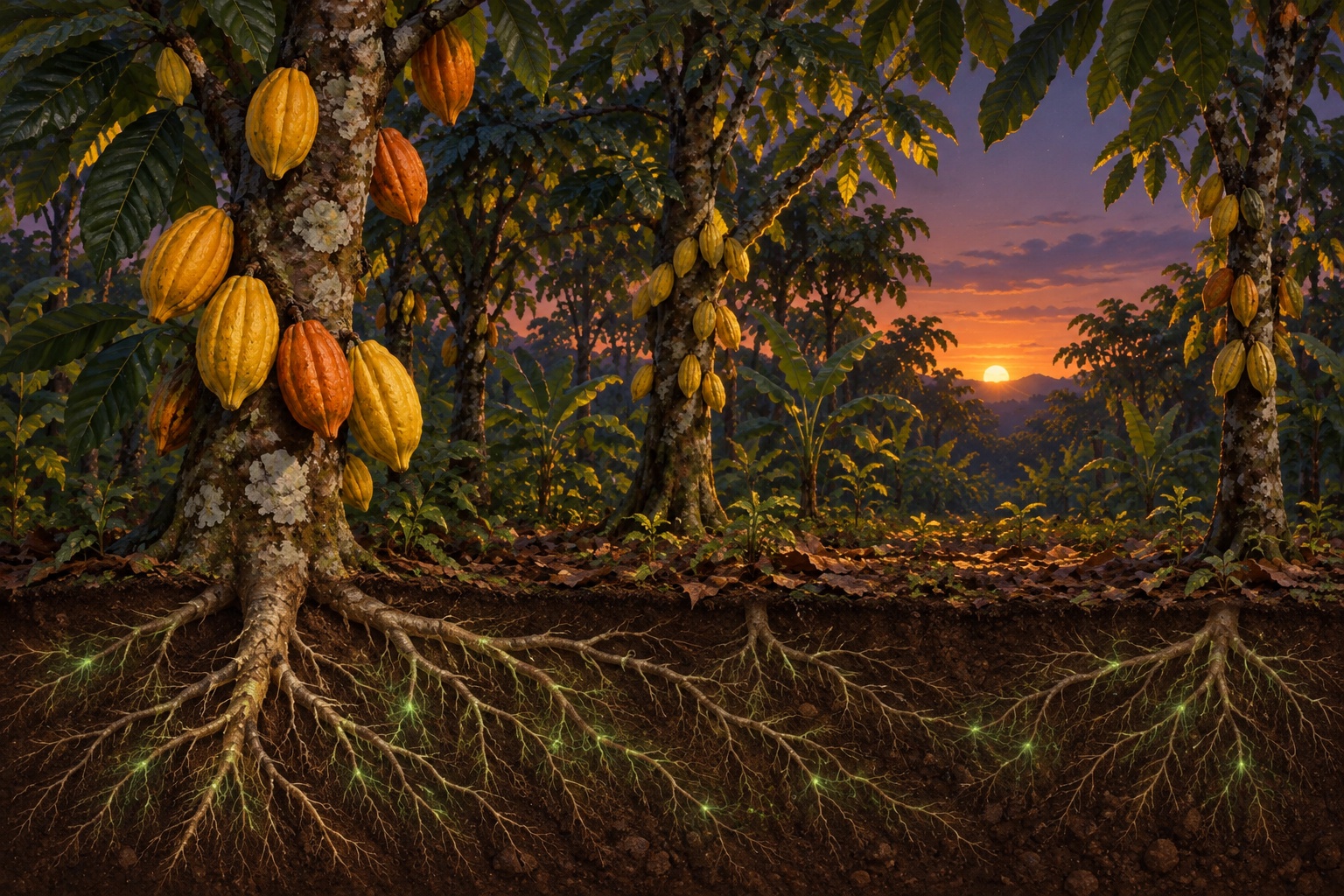
A cocoa drink begins with seeds inside a cacao pod. Theobroma cacao is a tropical tree: the cup connects to living roots, a shaded canopy and the processing that turns harvested seeds into cocoa.
Illustrative crop imagery · Not a GroundWorx customer site
The plant behind the cup
Warmth, moisture & protection
UF/IFAS describes cacao as adapted to hot, humid tropical conditions with well-distributed rainfall. Drought can cause leaf and flower drop; prolonged cold can damage plants. Its Florida home-landscape guide is regional context, not a worldwide climate threshold.
UF/IFAS describes cacao as an understory tree suited to partial shade and wind protection, while warning that deep shade can produce spindly, unproductive growth. INIAP’s Ecuador field research also identifies shade management as a subject needing further investigation—not one fixed shade rule for every farm.
UF/IFAS describes a seedling taproot plus lateral fibrous roots important for water and nutrient absorption. It calls for well-drained soil and access to moisture through dry periods. Soil wetness is not the same as air humidity, and one reading cannot represent an entire root system.
Cacao originated in the upper Amazon, with evidence of use in southeastern Ecuador about 5,300 years ago. Starch grains, residues and ancient DNA each confirmed that early use.
The guide describes fermentation, drying, cleaning, roasting and pressing in chocolate processing. This is a crop-to-cup overview, not a home-processing or food-safety recipe.
The GX-1 Series angle · GX-1 Series measurements could add a location-specific record of soil moisture, temperature and electrical conductivity beneath a managed cacao planting. No GroundWorx cacao trial or measured cocoa yield, water-saving or quality result has been verified for this profile. The external experiment below did not use GX-1 Series sensors or GAIN.
A root-zone record adds context beneath the crop: soil moisture, temperature and electrical conductivity at the measured location. Growers can consider that history alongside weather, field observations and their own agronomic advice.
These crop features are research context—not demonstrated crop performance, a sensor deployment prescription or a promise of beverage quality or yield.
INIAP Technical Bulletin 193 (2024) describes an adult-cacao field experiment in Balzar, Guayas, with different irrigation treatments, soil-moisture sensors and trunk dendrometers. The instruments measured different things: soil water conditions and changes in trunk diameter. See methodology and monitoring sections; these are external research instruments, not GroundWorx hardware.
In its conclusions (printed page 38), INIAP reports a relationship between stem water potential and maximum daily trunk contraction, suggesting trunk contraction as an indicator of plant water status. This is a study-specific association—not a predictive-accuracy score, a causal water-saving percentage or a transferable irrigation trigger. It does not validate GX-1 Series performance in cacao.