The cone behind the aroma
Brewing hops are the cones of female hop plants. Hops are perennial climbing plants; their above-ground growth returns each season from the underground crown.
Source ↗



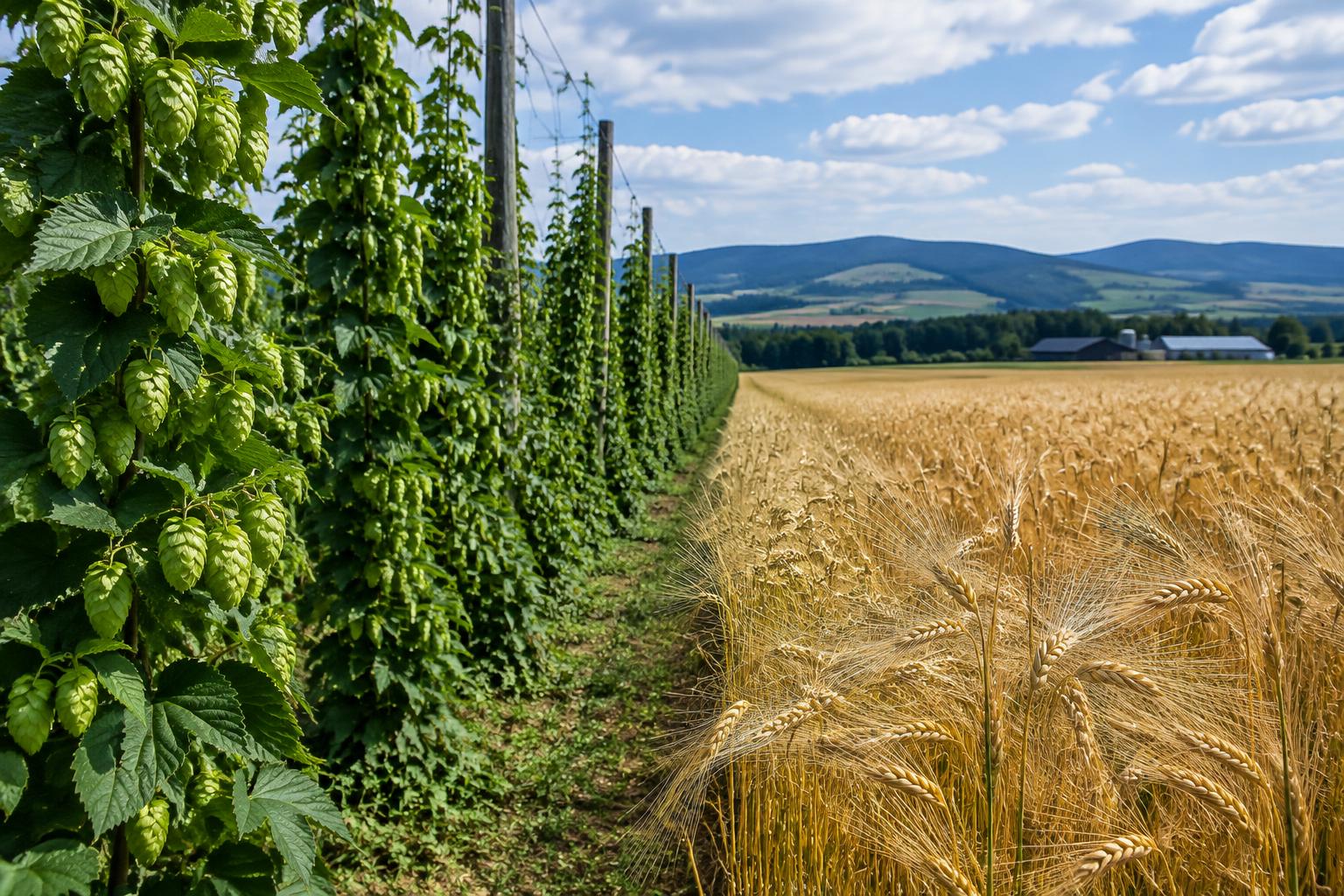
A perennial bine. An annual grain.
Long before the brewhouse, there is a hop yard and a field of grain. These two crops tell different stories: hops return from a living crown, while barley moves from seed to harvest in one growing season.
Illustrative crop imagery · Not a GroundWorx customer site
Brewing hops are the cones of female hop plants. Hops are perennial climbing plants; their above-ground growth returns each season from the underground crown.
Source ↗Barley is a familiar malting grain. Federal beer rules allow malt and malt substitutes, so barley and hops are not an exhaustive ingredient list for every beer style.
Source ↗Spring barley progresses through tillering, stem elongation, heading and grain filling before maturity. Hop production follows its own annual growth and cone-harvest cycle.
Source ↗General crop stages; timing varies with variety, region and management.
01
Hop shoots emerge from the perennial crown. Barley begins with seed germination, emergence and early leaves.
02
Hop bines climb their supports. Barley forms tillers before stems elongate: two distinct ways of building the season’s canopy.
03
Hops flower and develop cones. Barley heads emerge, followed by flowering and grain filling.
04
Hop cones are harvested and the perennial plant enters its resting cycle. Barley grain reaches maturity and is harvested.
The GX-1 series angle · In barley ground, a GX-1A can record moisture, temperature and EC through tillering, heading and grain fill; around a hop crown, a buried GX-1F can follow the perennial root zone the plant returns from each spring.
A root-zone record adds context beneath the crop: soil moisture, temperature and electrical conductivity at the measured location. Growers can consider that history alongside weather, field observations and their own agronomic advice.
These crop features are research context—not demonstrated crop performance, a sensor deployment prescription or a promise of beverage quality or yield.
Discuss a grower pilot