A cone, not a true berry
Common juniper’s fleshy, berry-like seed cones are used to flavor gin. This is the botanical flavoring story, not a claim that juniper supplies all of the drink’s ingredients.
Source ↗



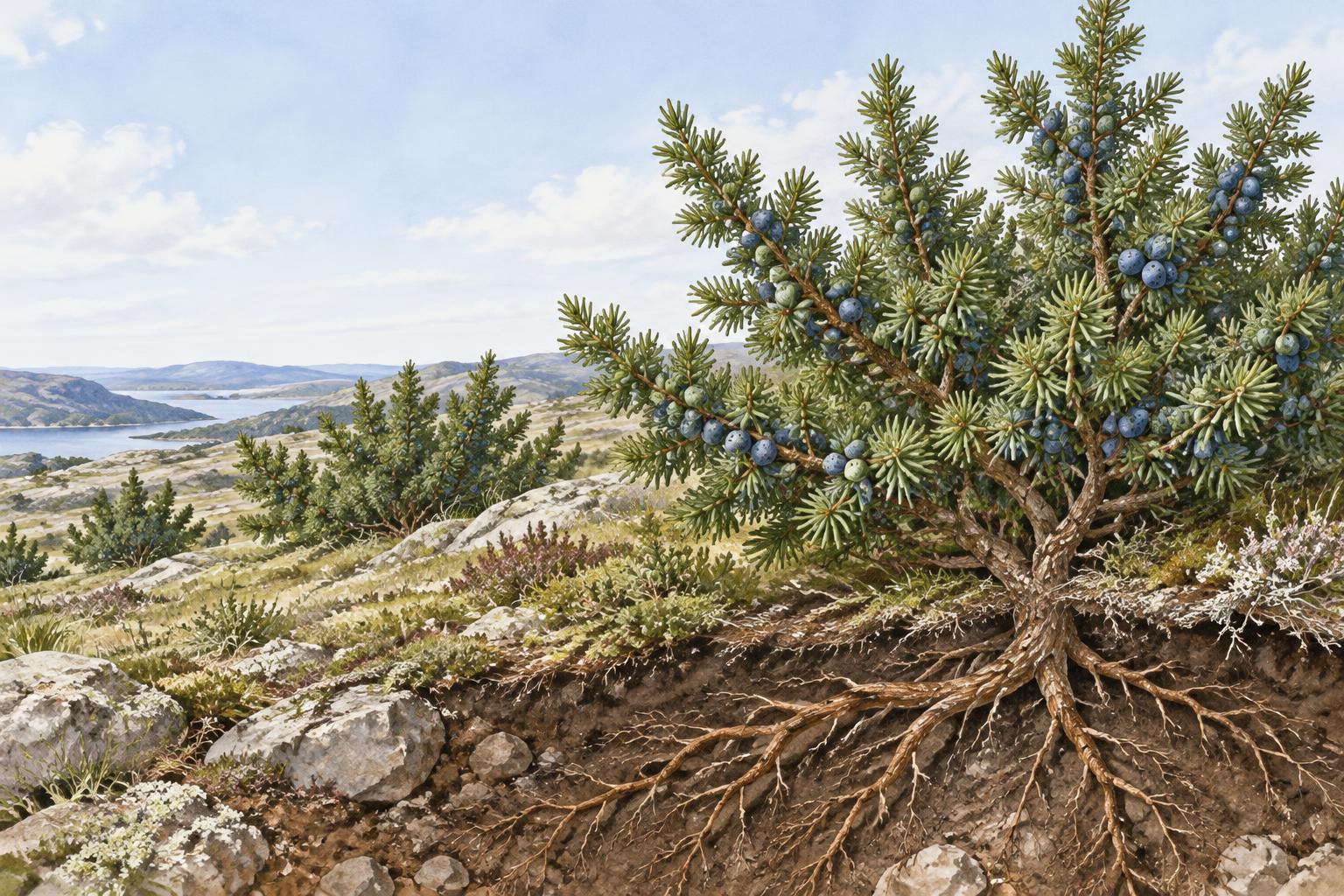
Juniperus communis · An evergreen shrub or small tree
Before gin reaches the glass, common juniper supplies a botanical connection to the land. Its blue “berries” are fleshy seed cones, carried by an evergreen plant found across much of the Northern Hemisphere.
Illustrative juniper imagery · Roots are unscaled artistic interpretation, not measured depth or architecture · Not a GroundWorx customer site
Common juniper’s fleshy, berry-like seed cones are used to flavor gin. This is the botanical flavoring story, not a claim that juniper supplies all of the drink’s ingredients.
Source ↗The U.S. Forest Service describes common juniper across North America, Europe, northern Asia and Japan. Its broad native distribution is not a map of commercial gin supply or a single domestication origin.
Source ↗NC State describes a preference for well-drained soil in full sun. The Forest Service reports varied habitats, including rocky slopes and sandy sites, and notes well-aerated soils in much of its European range. These are habitat descriptions, not one universal irrigation target.
Source ↗General crop stages; timing varies with variety, region and management.
01
Cone development generally occurs in spring, with dates varying by location. Common juniper usually carries male and female cones on separate plants.
Source ↗02
Female plants develop green, fleshy seed cones that gradually change color as they mature.
Source ↗03
Cones commonly ripen in the second or third year. New and older cone cohorts can therefore belong to different growing seasons.
Source ↗04
Mature cones become dark blue to black. Birds feed on the cones and help disperse the seeds; this is not a foraging or food-safety guide.
Source ↗The GX-1 series angle · For a managed juniper planting, GX-1 series measurements could add a location-specific soil record. This is a research use case, not a verified juniper deployment or proof of gin quality. No universal juniper root depth or sensor placement depth is established here.
A root-zone record adds context beneath the crop: soil moisture, temperature and electrical conductivity at the measured location. Growers can consider that history alongside weather, field observations and their own agronomic advice.
These crop features are research context—not demonstrated crop performance, a sensor deployment prescription or a promise of beverage quality or yield.
Discuss a grower pilot