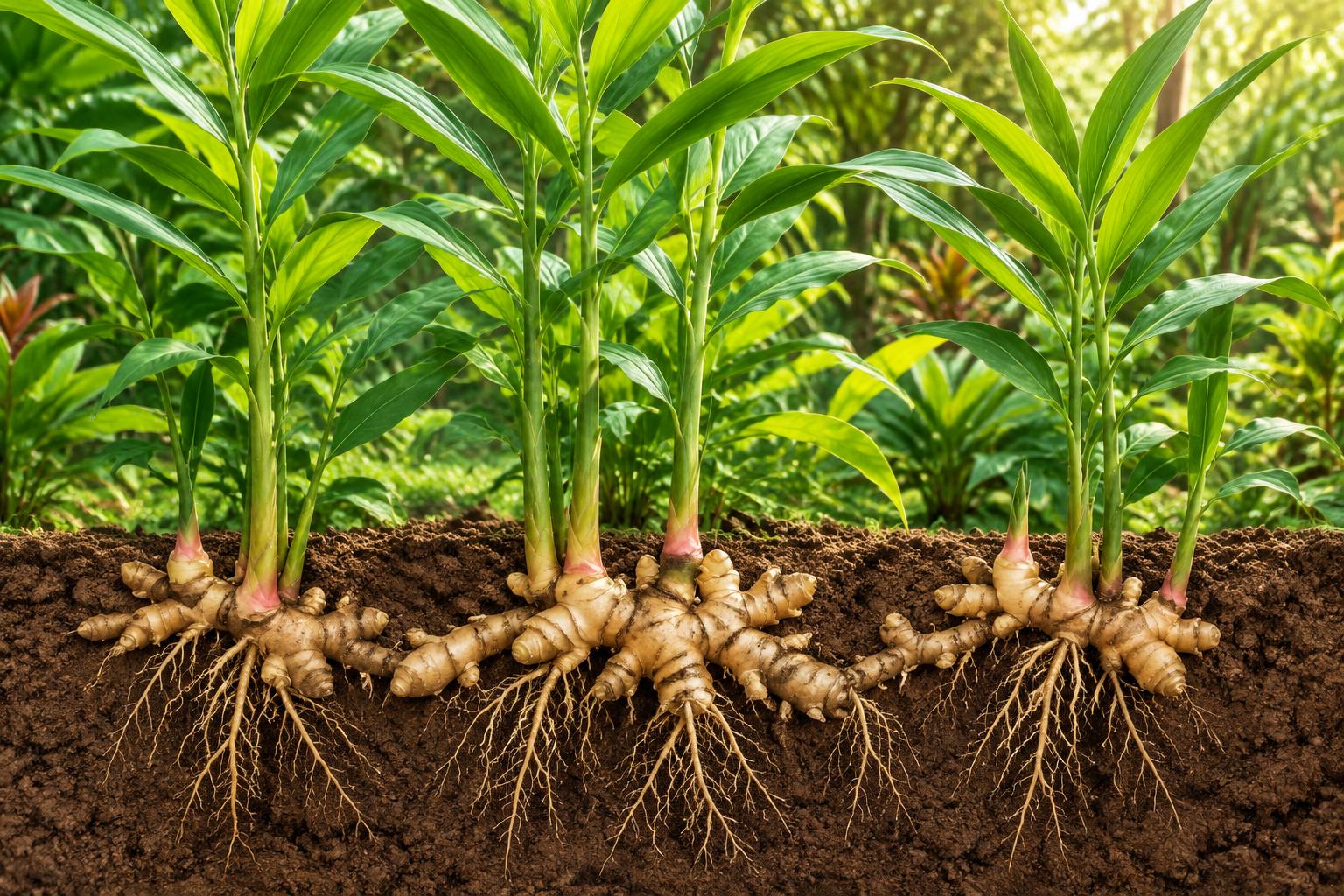
Often sold as “ginger root,” the aromatic part behind this cup is an underground stem called a rhizome. Culinary ginger connects a tropical plant, a living soil environment and a familiar herbal drink.
Illustrative ginger · Rhizomes and roots are unscaled artistic interpretation, not measured depth or architecture · Not a GroundWorx customer site
The plant behind the cup
A stem beneath the soil
Wisconsin Extension and UF/IFAS identify edible ginger as the rhizome of Zingiber officinale—an underground stem, not a botanical root. UF/IFAS documents it as an herbal-tea ingredient; Wisconsin also records its use in teas.
UC Master Gardeners describes warm, humid conditions and loose, well-amended, well-drained soil, kept moist rather than wet. UF/IFAS likewise emphasizes drainage and organic matter. These descriptions are growing context, not a universal moisture percentage or irrigation trigger.
UF/IFAS and UC Master Gardeners describe partial shade. Wisconsin notes that plants can do well in full sun in its cooler climate while more southern locations may need partial shade. One sunlight rule should not be applied worldwide.
NC State describes ginger’s origin broadly as tropical Asia. Wisconsin describes Southeast Asian forest habitats and records a long spice-trade history; UC’s regional guide names southern China. These accounts are not reduced to a proven single domestication site or a birthplace for ginger drinks. The story is about culinary ginger, not unrelated wild gingers.
General crop stages; timing varies with variety, region and management.
01
Buds on planting material
Ginger is commonly propagated from rhizome pieces with viable buds. The term “seed ginger” refers to that planting material rather than an ordinary seed-sown crop.
New shoots rise from the rhizome and carry narrow green leaves. Wisconsin describes those leafy shoots as pseudostems formed by tightly wrapped leaf sheaths.
Young “baby” ginger is more tender and less fibrous than mature ginger. UC and Wisconsin describe different harvest timing for their settings; crop stage and local season matter more than a single worldwide calendar.
UF/IFAS lists ginger as an herbal-tea ingredient and a base for ginger beverages. This feature covers culinary Zingiber officinale, not ornamental gingers or unrelated wild gingers; it is not a foraging or food-safety guide.
The GX-1 series angle · A managed culinary-ginger crop could pair location-specific soil moisture, temperature and electrical-conductivity records with growth stage, rainfall and grower observations. No verified GroundWorx ginger trial or sensor result is available in the reviewed project evidence; no root-depth target, predictive-accuracy score, water savings, health benefit or drink-quality guarantee is claimed.
A root-zone record adds context beneath the crop: soil moisture, temperature and electrical conductivity at the measured location. Growers can consider that history alongside weather, field observations and their own agronomic advice.
These crop features are research context—not demonstrated crop performance, a sensor deployment prescription or a promise of beverage quality or yield.