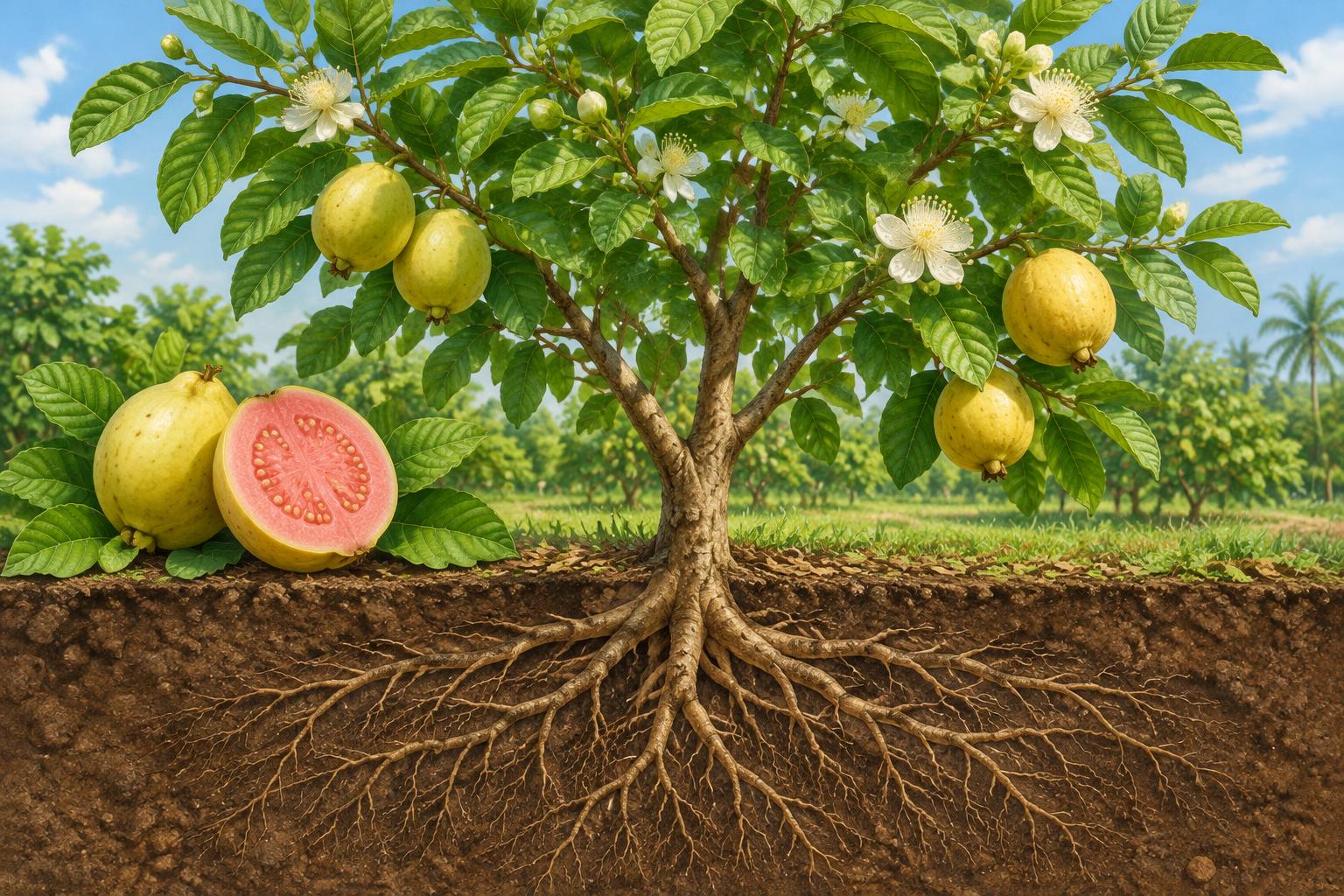
A fragrant fruit connects this glass to a woody tropical tree. Common guava, Psidium guajava, supplies pulp for juice and other beverages; it is distinct from related fruits that also carry the guava name.
Illustrative guava · Roots are unscaled artistic interpretation, not measured depth or architecture · Not a GroundWorx customer site
The plant behind the cup
Fruit behind the juice
UF/IFAS documents guava used as puree and juice. Julia Morton’s reference, hosted by Purdue, independently records guava juice and nectar beverages in the Caribbean. These are ingredient and regional-use accounts, not a current market-size claim or a fermentation recipe.
UF/IFAS describes adaptation to warm subtropical and tropical conditions and full sun for best growth and fruit production. Morton likewise describes guava in warm climates and notes cold damage, especially to young trees. These accounts do not establish one worldwide temperature threshold.
UF/IFAS distinguishes drought tolerance from drought effects on fruit set and size, and warns that prolonged flooding can damage the tree. Morton recommends good drainage. UF/IFAS states that specific mature-tree water requirements have not been determined; no universal watering volume or moisture percentage is supplied here.
UF/IFAS describes guava as indigenous to the American tropics and now naturalized across tropical and subtropical regions. Morton’s 1987 account says its precise origin is uncertain after long cultivation and dispersal, proposing southern Mexico through Central America. That qualified plant history does not establish a single birthplace for guava juice, and historical production figures are not current statistics.
General crop stages; timing varies with variety, region and management.
01
Establishing the tree
Both sources describe seed and vegetative propagation. Seed-grown plants do not reliably reproduce the parent cultivar; selected cultivars can instead be propagated vegetatively. This is botanical context, not a propagation protocol.
UF/IFAS describes white flowers in leaf axils on recent growth. Self-pollination is possible, while insect cross-pollination can improve yields in the account given; this is not a guarantee of fruit set for every planting.
UF/IFAS distinguishes pink or red types generally picked as peel turns light green to yellow from white types intended for crisp eating while green. Flesh color and intended use matter; one ripeness rule or harvest calendar should not be applied to all guavas.
The harvested fruit can become puree, juice or nectar. Morton records Caribbean bottled or canned beverages as historical context. Processing and safe storage require their own guidance; no home-preservation recipe is supplied here.
The GX-1 series angle · A managed guava planting could pair location-specific soil moisture, temperature and electrical-conductivity records with cultivar identity, flowering, fruit development and weather observations. No verified GroundWorx guava trial or sensor result is available in the reviewed project evidence; no predictive accuracy, root-depth target, water savings, health benefit or juice-quality guarantee is claimed. UF/IFAS flags guava as invasive and not recommended for planting in south Florida; this reference is not an invitation to plant it everywhere.
A root-zone record adds context beneath the crop: soil moisture, temperature and electrical conductivity at the measured location. Growers can consider that history alongside weather, field observations and their own agronomic advice.
These crop features are research context—not demonstrated crop performance, a sensor deployment prescription or a promise of beverage quality or yield.