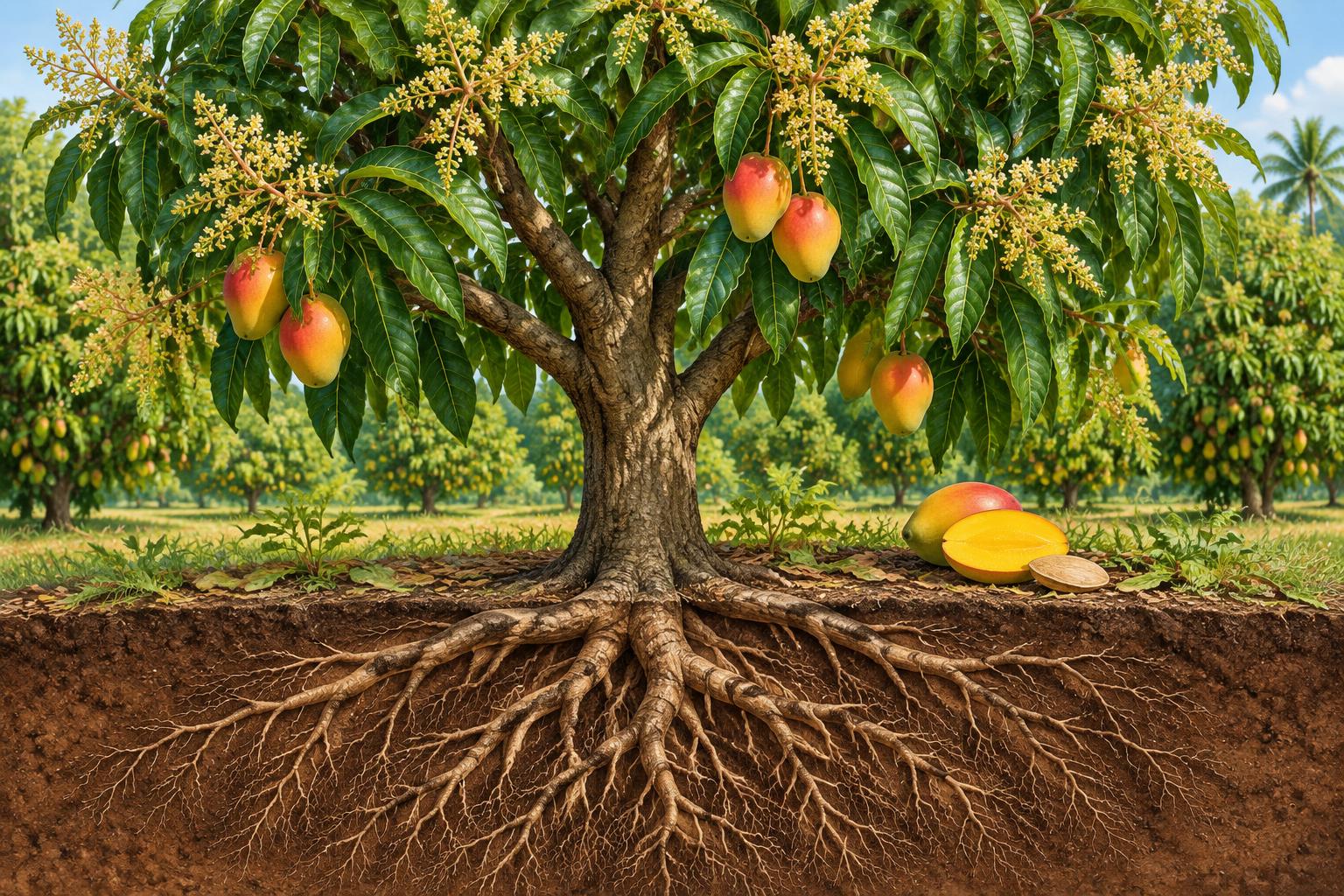
Golden mango flesh connects a familiar drink to a long-lived tropical tree. This feature follows Mangifera indica from its growing environment to juice and nectar ingredients, without treating every cultivar or climate as interchangeable.
Illustrative mango · Roots are unscaled artistic interpretation, not measured depth or architecture · Not a GroundWorx customer site
The plant behind the cup
Flesh behind the glass
Julia Morton’s 1987 reference, hosted by Purdue, documents ripe mango made into nectar and mango juice consumed as a beverage. UF/IFAS describes fleshy drupes with a large flattened seed enclosed in a woody husk. The drink ingredient is fruit flesh, not the stone; the historical account is not a current market statistic or a processing recipe.
UF/IFAS describes mango in tropical, subtropical and warm locations generally without freezing temperatures, and recommends full sun for growth and fruit production. Morton independently describes tropical and near-tropical cultivation. Cold can damage flowers and young fruit; no worldwide temperature threshold or hardiness guarantee is supplied here.
UF/IFAS says mango adapts to several soil types but performs poorly in poorly drained soils. Morton likewise emphasizes good drainage. UF/IFAS distinguishes watering young trees from mature-tree care in Florida; those regional recommendations are not a universal irrigation schedule or soil-moisture percentage.
UF/IFAS describes mango’s origin in the Indo-Burma region and indigenous range in India and Southeast Asia. Morton describes southern Asian nativity and a long history of cultivation and dispersal into other tropical regions. These regional plant accounts do not establish one birthplace or invention date for mango juice; historical production figures are not current statistics.
General crop stages; timing varies with variety, region and management.
01
Establishing a cultivar
UF/IFAS describes seed and vegetative propagation, including grafting. Monoembryonic and polyembryonic seed types differ; a mango seed should not automatically be assumed to reproduce a chosen cultivar.
Both references describe branched flower panicles at shoot ends and insect pollination. Not every flower sets a mature fruit; local weather and cultivar belong alongside flowering observations.
Mango fruit varies in shape, skin color and flesh characteristics among cultivars. UF/IFAS describes different maturity seasons in Florida; those dates are not presented as one worldwide harvest calendar.
UF/IFAS distinguishes mature fruit at harvest from subsequent ripening. Morton documents juice and nectar uses of the flesh. This is crop-to-drink context, not a preservation, food-safety or home-processing guide.
The GX-1 series angle · A managed mango planting could pair location-specific soil moisture, temperature and electrical-conductivity records with cultivar, flowering, rainfall and harvest observations. No verified GroundWorx mango trial or sensor result is available in the reviewed project evidence; no root-depth target, predictive accuracy, water savings, health benefit or beverage-quality guarantee is claimed.
A root-zone record adds context beneath the crop: soil moisture, temperature and electrical conductivity at the measured location. Growers can consider that history alongside weather, field observations and their own agronomic advice.
These crop features are research context—not demonstrated crop performance, a sensor deployment prescription or a promise of beverage quality or yield.