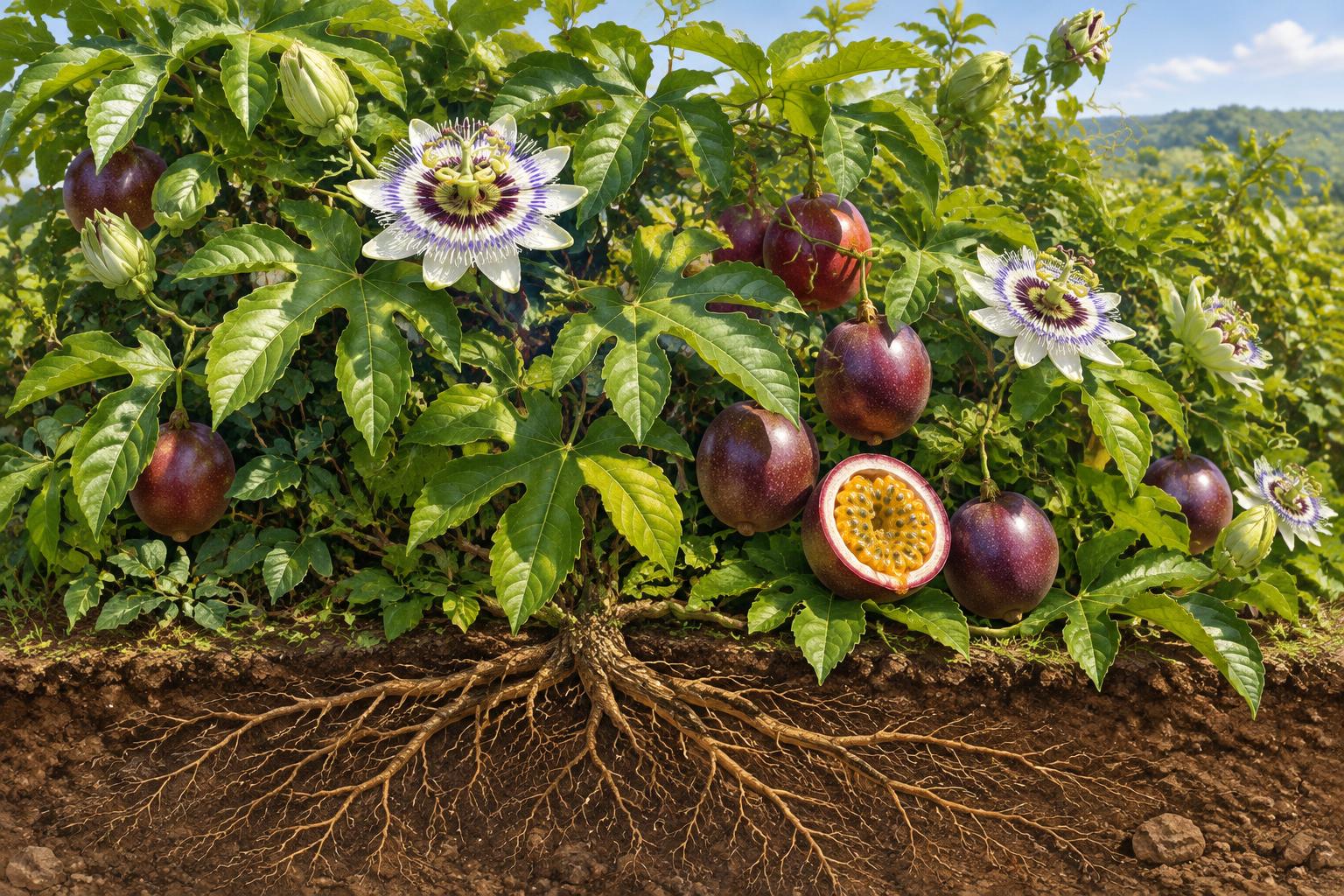
Inside a tough rind, seeds carry aromatic, juicy pulp. This passion-fruit story follows Passiflora edulis from a climbing vine to a nonalcoholic juice—not every ornamental passionflower.
Illustrative passion fruit · Roots are unscaled artistic interpretation, not measured depth or architecture · Not a GroundWorx customer site
The plant behind the cup
Pulp behind the pour
UC Extension describes edible seeds surrounded by juicy orange-colored pulp and documents juice blended with other fruit juices. UF/IFAS likewise describes juice sacs used in beverages. This feature concerns nonalcoholic juice, not fermented drinks.
Both university guides emphasize well-drained soil. UC Extension cautions that overwatering can favor soil diseases while underwatering can leave roots too dry. These observations do not establish a universal moisture percentage or irrigation trigger.
UF/IFAS describes full sun in its Florida setting. UC Extension favors full sun along the California coast but cautions against inland full sun in hot, dry conditions. Purple and yellow forms also differ in cold tolerance; one climate rule should not be applied worldwide.
UC Extension describes purple passion fruit as native to southern Brazil, Paraguay and northern Argentina. UF/IFAS discusses tropical American origins and a juice tradition experienced in St. Vincent and the Grenadines. Native range and a regional drink account do not establish a single birthplace for passion-fruit juice; the uncertain ancestry of yellow forms is not treated as settled here.
General crop stages; timing varies with variety, region and management.
01
A climbing framework
Passion fruit is a perennial vine. UF/IFAS describes propagation from seeds and cuttings as well as grafting and other methods; the plant needs support as it grows.
Both sources connect flowering and pollination to fruit set. Pollination requirements vary among forms and cultivars; an attractive flower alone does not guarantee a fruit crop.
UF/IFAS describes mature fruit coloring and falling from the vine. UC Extension also documents harvesting colored fruit or collecting fallen fruit. These regional descriptions are not a worldwide harvest calendar.
UC Extension documents juice and juice blends; UF/IFAS describes adding passion-fruit juice to other juices or diluting it with water. This is a crop-to-drink reference, not a preservation recipe or food-safety guide.
The GX-1 series angle · A managed passion-fruit crop could pair location-specific soil moisture, temperature and electrical-conductivity records with cultivar identity, flowering, fruit development and weather observations. No verified GroundWorx passion-fruit trial or sensor result is available in the reviewed project evidence; no predictive accuracy, root-depth target, water savings, health benefit or juice-quality guarantee is claimed.
A root-zone record adds context beneath the crop: soil moisture, temperature and electrical conductivity at the measured location. Growers can consider that history alongside weather, field observations and their own agronomic advice.
These crop features are research context—not demonstrated crop performance, a sensor deployment prescription or a promise of beverage quality or yield.