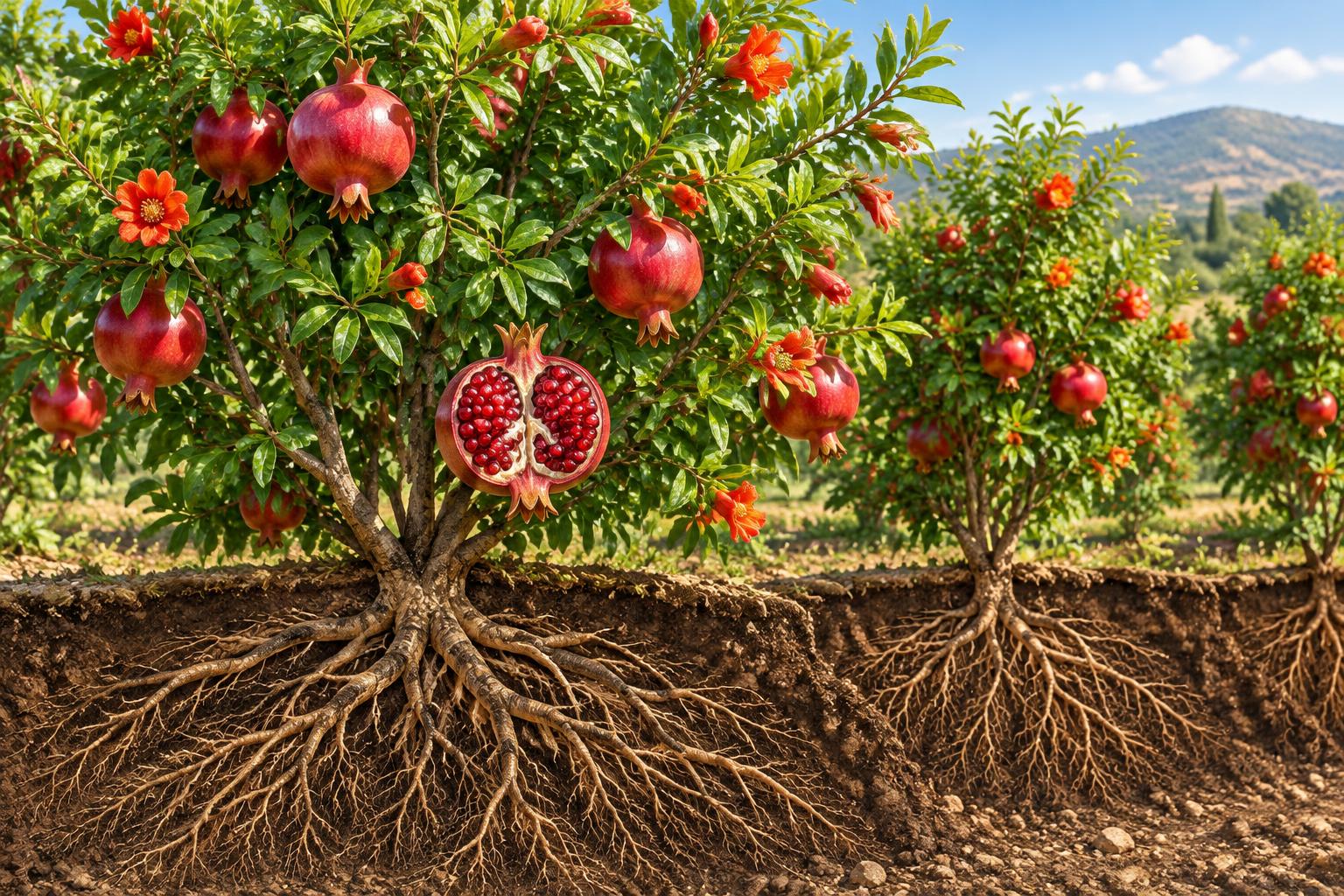
A leathery fruit holds a collection of juice-filled arils around its seeds. Pomegranate juice connects those small compartments to a perennial shrub or tree—and to growing conditions that differ across regions.
Illustrative pomegranate · Roots are unscaled artistic interpretation, not measured depth or architecture · Not a GroundWorx customer site
The plant behind the cup
Juice around the seed
UF/IFAS describes the juice-containing structures around the seeds as arils. Texas A&M likewise describes juicy, edible arils and documents fruit juice made into beverages or blended with other juices. This page concerns nonalcoholic juice, not pomegranate wine.
Texas A&M and Clemson describe full sun for best flowering and fruiting, with good soil drainage. These general conditions do not supply a universal planting depth, salinity limit or soil-moisture target.
UF/IFAS describes most cultivars thriving in Mediterranean environments but many producing poorly in Florida because of disease and climate. Clemson also notes weaker fruiting in humid South Carolina. Plant survival or flowers alone do not establish reliable fruit production.
Clemson says the precise origin is unknown and describes a native range from the Middle East to the Himalayas. Texas A&M records long cultivation across Mediterranean regions and introduction to the Americas by Spanish missionaries. Plant range and cultivation history are not a proven single birthplace or invention date for pomegranate juice.
General crop stages; timing varies with variety, region and management.
01
Perennial framework
Pomegranate is commonly grown as a bushy shrub and can be trained as a small tree. Most cultivars are deciduous; UF/IFAS notes some reported evergreen types in tropical and subtropical settings.
Clemson describes flowers and variation among ornamental forms, noting that double-flowering cultivars produce few, if any, fruits. A showy flowering plant is not necessarily a productive juice cultivar.
Clemson describes even soil moisture as helping reduce fruit drop and splitting. This is general crop context, not a guarantee against splitting or a sensor-controlled watering instruction.
Texas A&M states that pomegranates do not ripen after picking and documents juice used in beverages and blends. Maturity and processing are distinct steps; no home-preservation or food-safety recipe is provided here.
The GX-1 series angle · A managed pomegranate planting could pair location-specific soil moisture, temperature and electrical-conductivity records with cultivar identity, flowering, fruit development and weather observations. No verified GroundWorx pomegranate trial or sensor result is available in the reviewed project evidence; no predictive accuracy, root-depth target, water savings, health benefit or juice-quality guarantee is claimed.
A root-zone record adds context beneath the crop: soil moisture, temperature and electrical conductivity at the measured location. Growers can consider that history alongside weather, field observations and their own agronomic advice.
These crop features are research context—not demonstrated crop performance, a sensor deployment prescription or a promise of beverage quality or yield.