Rye leads the U.S. mash
The U.S. standard for rye whisky requires a fermented mash of at least 51% rye grain, alongside other production requirements. This is a U.S. type definition, not a rule for every whiskey worldwide.
Source ↗



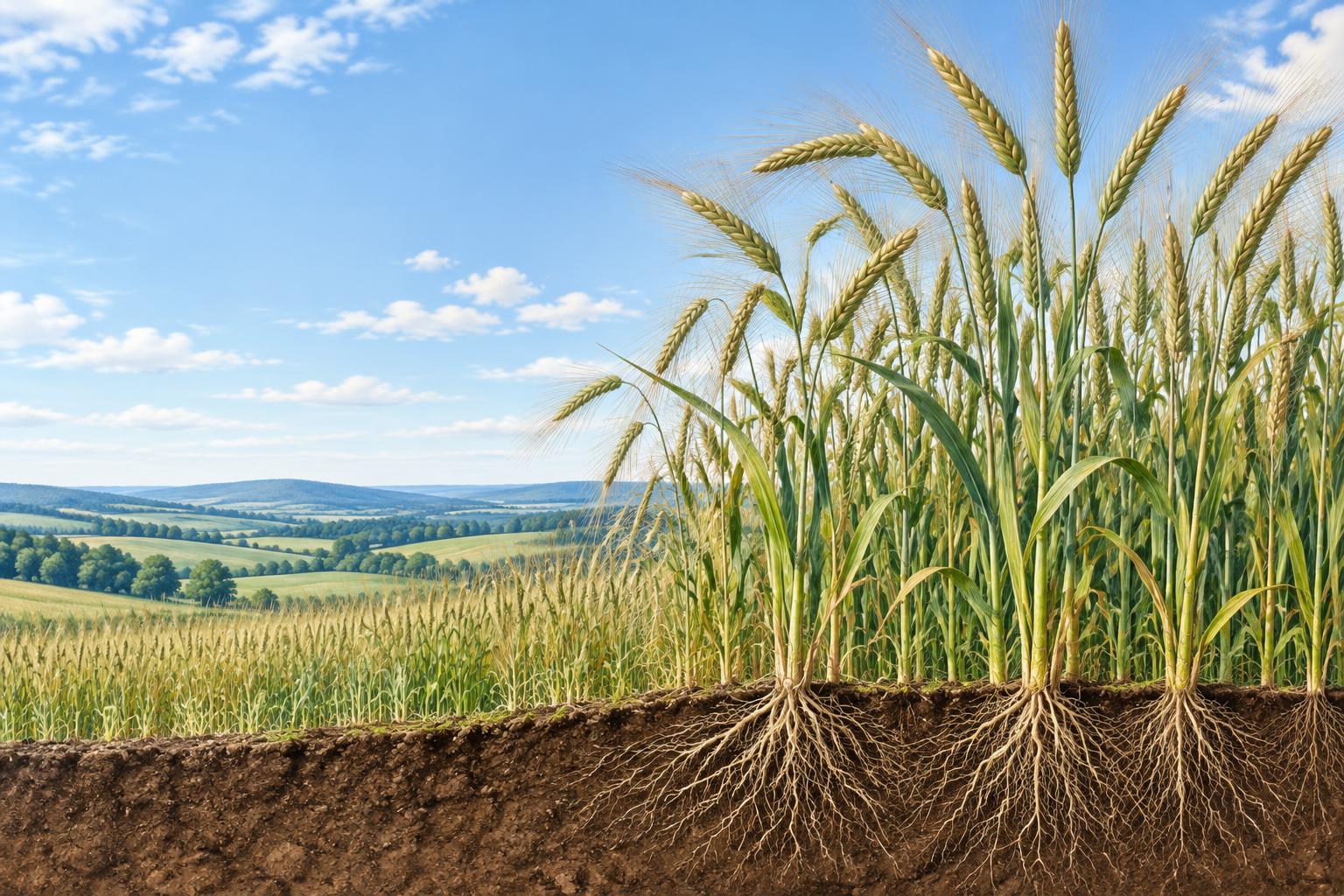
Secale cereale · Cereal rye, not ryegrass
Before rye whiskey reaches a barrel, cereal rye grows as a cool-season grain. The crop also has a separate life as a cover crop: the same species, but a different harvest goal.
Illustrative cereal rye · Roots are unscaled artistic interpretation, not measured depth or architecture · Not a GroundWorx customer site
The U.S. standard for rye whisky requires a fermented mash of at least 51% rye grain, alongside other production requirements. This is a U.S. type definition, not a rule for every whiskey worldwide.
Source ↗Cereal rye is a cool-season annual grass. SARE describes a quick-growing fibrous root system without a taproot; this is cereal rye (Secale cereale), not ryegrass.
Source ↗UC Davis describes cereal rye as a cover crop, including uses in vineyards and orchards. Cover-crop management and distilling-grain production have different goals; cover-crop findings do not establish whiskey-grain yields.
Source ↗Cereal rye Secale cereale
UC Davis describes cereal rye as thought to be native to the mountains of southwestern Asia. Britannica likewise qualifies its probable cultivation origin there. This is a qualified crop-origin account, not a settled birthplace of rye whiskey.
UC Davis SAREP — Cereal Rye: geographic range ↗General crop stages; timing varies with variety, region and management.
01
Winter rye can establish in autumn. Local climate, variety and the intended grain or cover use shape its calendar.
Source ↗02
Established plants and their roots occupy the field through the winter cycle. SARE discusses this specifically in cover-crop systems.
Source ↗03
Rye resumes growth in spring. UC Davis describes long-day flowering and distinguishes winter rye from available spring-sown varieties.
Source ↗04
A grain crop is carried toward maturity; a cover crop may instead be terminated. Those endpoints should not be presented as one universal harvest schedule.
Source ↗The GX-1 series angle · Location-specific soil observations could add research context beneath a managed rye field. No universal root depth, irrigation threshold, verified rye deployment or whiskey-quality improvement is established here.
A root-zone record adds context beneath the crop: soil moisture, temperature and electrical conductivity at the measured location. Growers can consider that history alongside weather, field observations and their own agronomic advice.
These crop features are research context—not demonstrated crop performance, a sensor deployment prescription or a promise of beverage quality or yield.
Discuss a grower pilot